Sculptures
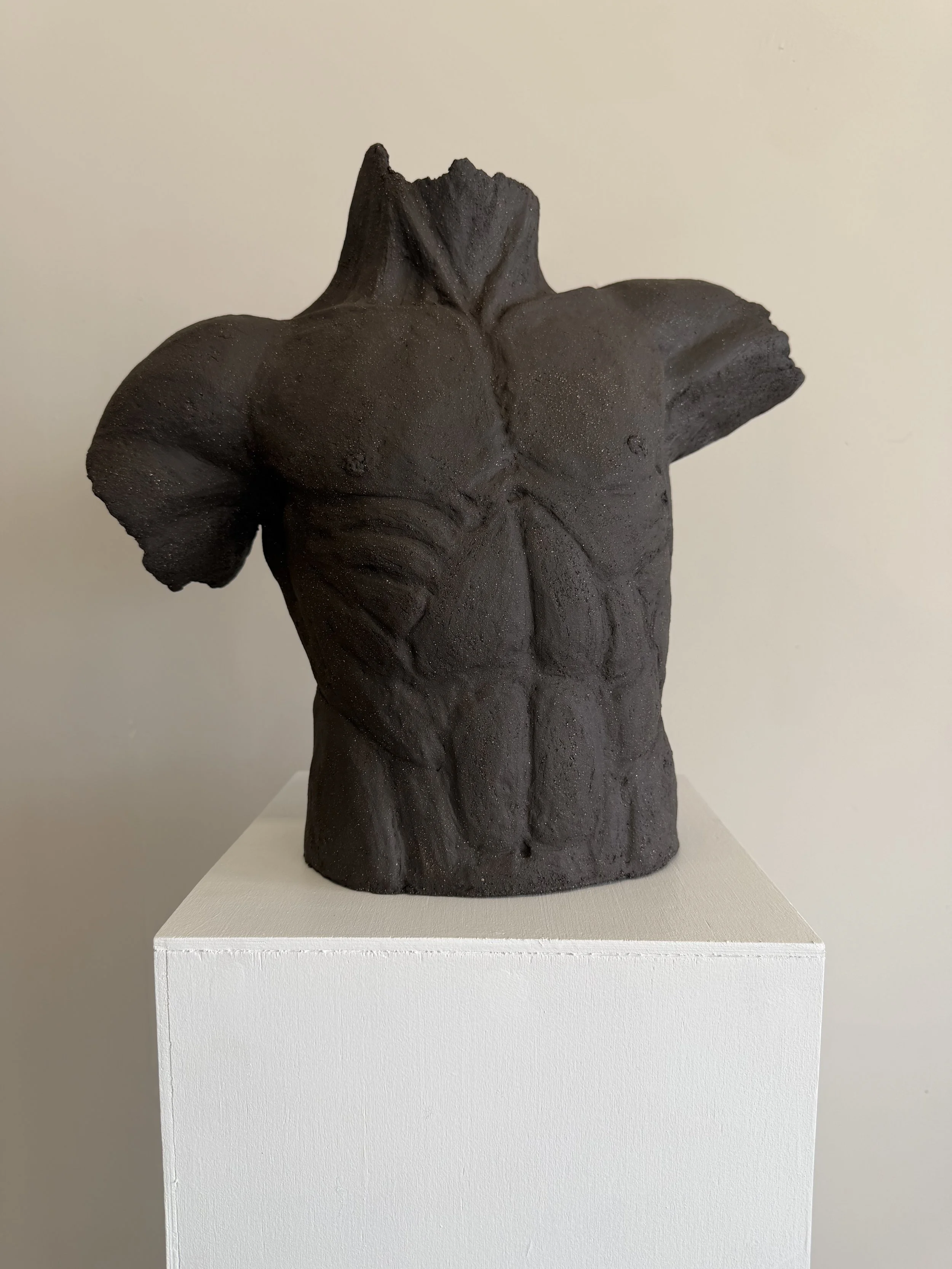
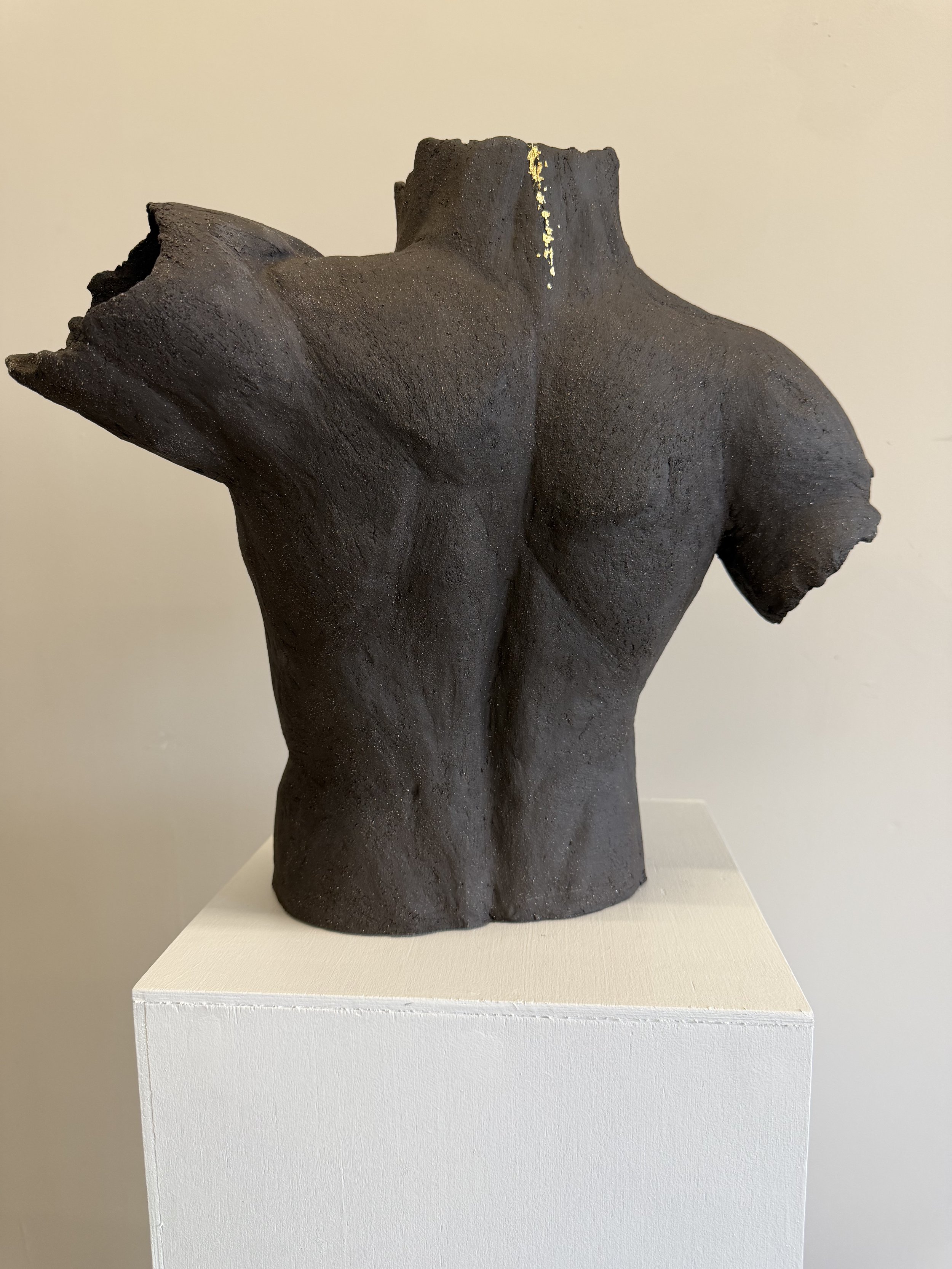
In Black Diamond, dance is condensed into an interrupted presence. A headless, armless torso rises as a compact mass in which anatomy becomes architecture: ribcage, spine, and musculature form a tense verticality, like a movement suspended at its point of maximum charge. The black surface absorbs rather than reflects light, giving the form an almost mineral density, physical yet restrained.
The work reads as an interval rather than a narrative. Between chest and back, volumes tighten and release, establishing a silent rhythm of expansion and restraint. What would normally articulate the gesture is removed, shifting attention inward, toward breath, balance, torsion. Subtle asymmetries and surface irregularities prevent idealization, sustaining a quiet vibration that keeps the stillness alive.
Between control and vulnerability, fracture becomes structure. In a spirit akin to kintsugi, cracks and omissions are acknowledged as integral to the form. The sculpture invites sustained attention, asking the viewer to complete the suspended gesture inwardly and to experience the body as a discreet instrument of feeling.
Material: PRNF
Price: €1800 (SOLD)
35h x 40w x 18d
Black Diamond
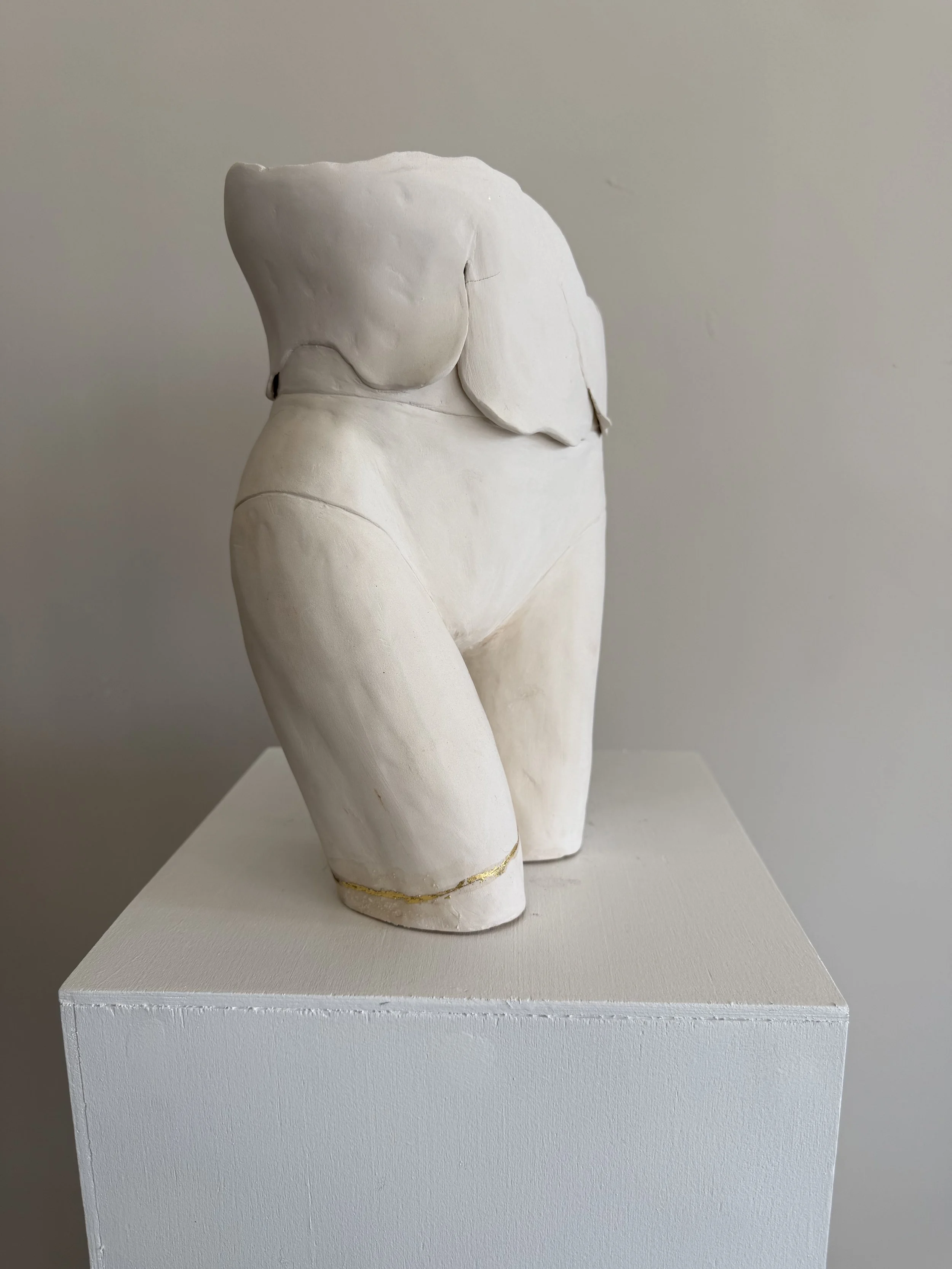
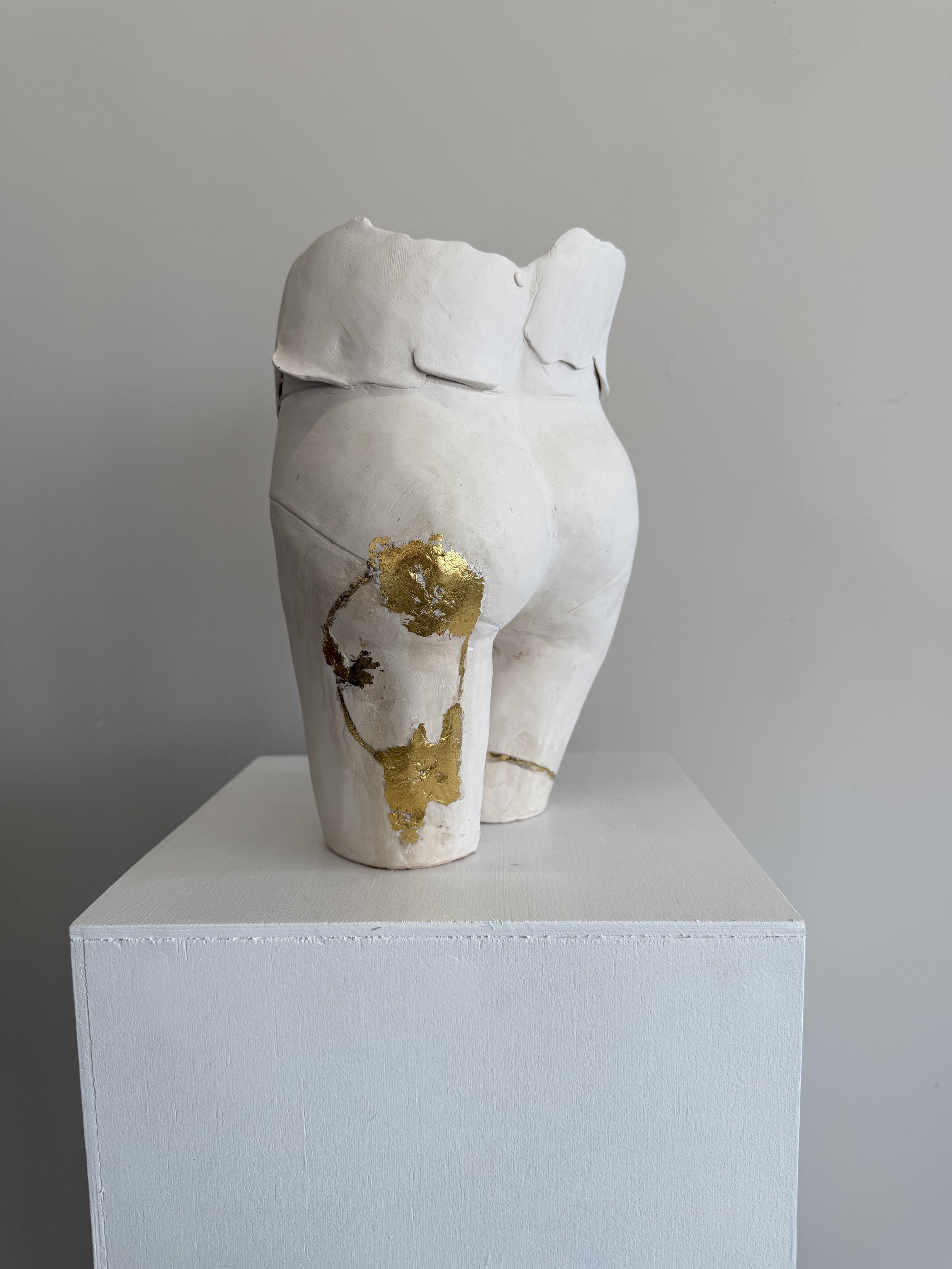
This artwork shows a fragment of a body, reduced to the pelvis and legs. That framing goes straight to what matters in dance: support, weight, contained momentum. The volumes are compact, almost architectural, yet animated by small imbalances, a hip that tilts, an axis that shifts, that let movement be sensed without ever narrating it.
The matte white catches light softly and makes the material feel present: the hand, the firing, the tiny variations of the surface. Cracks and breaks are not hidden; on the contrary, they are repaired in gold following the principle of kintsugi. The repair remains visible and becomes a compositional line, a kind of punctuation within the form.
The sculpture holds precision and accident together. It speaks of a body that endures, of an emotion given structure, and of a beauty built from the fault rather than against it.
Material: PRAI with Kintsugi
Price: €1500
27h x 17w x 12d
Martha Graham
Ashley Murphy
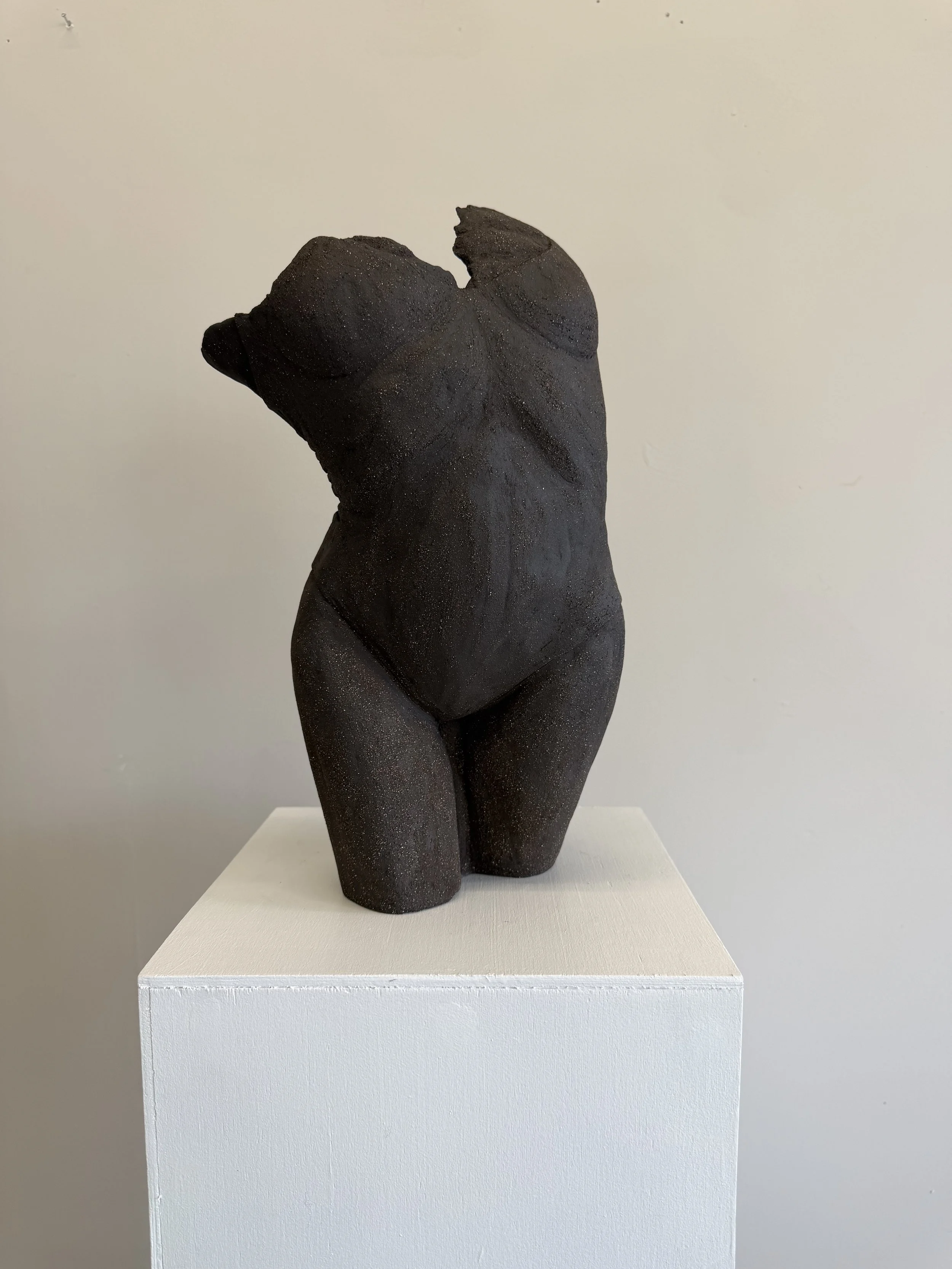
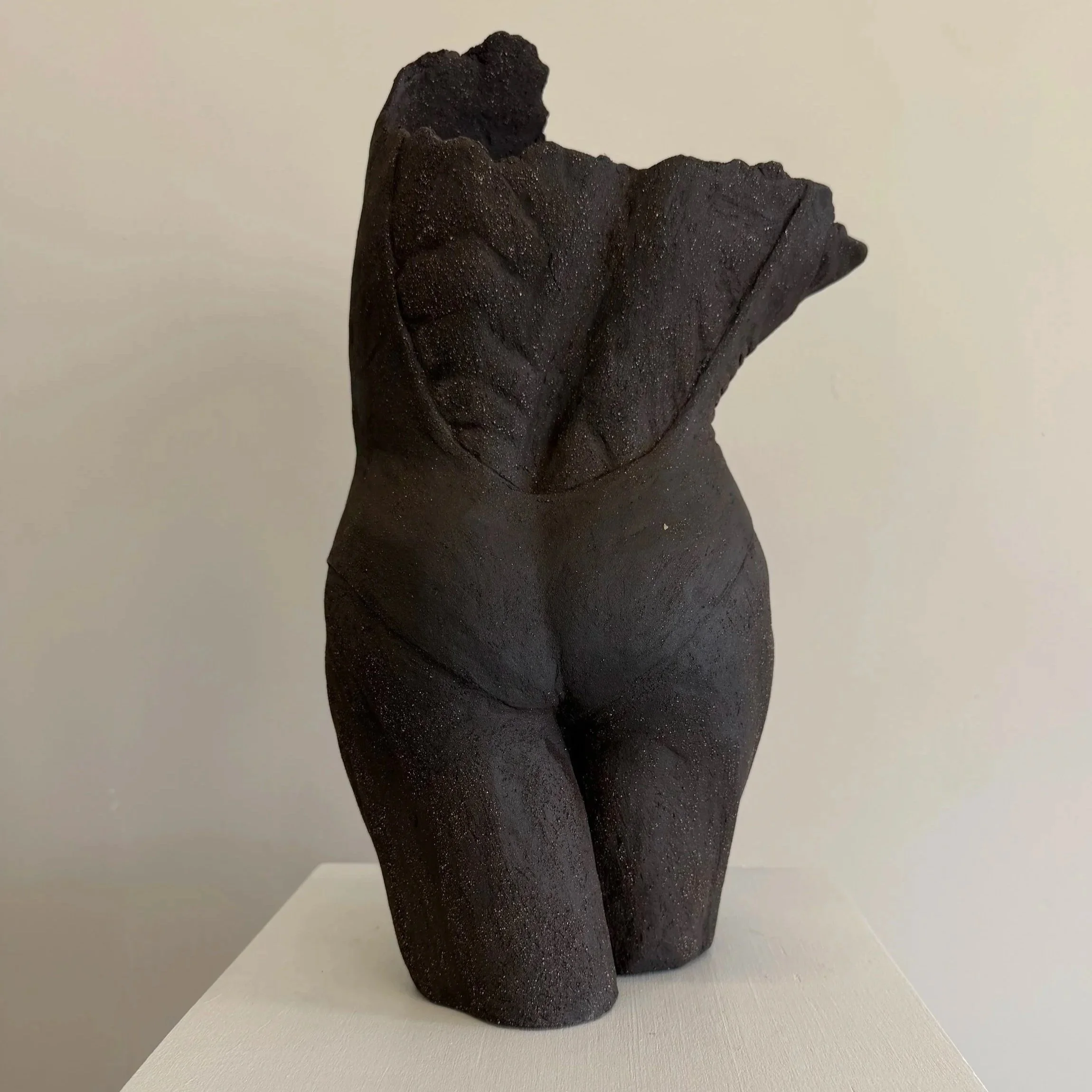
In Ashley Murphy, the body appears fragmented, reduced to the bust and hips, kneeling as if in the suspended moment following a turn. The black ceramic absorbs light, drawing attention to mass and support. The volume is dense, almost silent; anatomy is not described for its own sake but used as a point of tension. The sharp cut at the shoulders opens the form, as though the gesture had been abruptly interrupted, allowing the movement to continue in the viewer’s mind.
The sculpture unfolds through a dialogue between stability and torsion. From the front, the torso appears slightly shifted, held within a short breath. From behind, the spine and shoulder blades emerge in relief, organizing an internal axis that suggests rotation despite stillness. Subtle surface variations and asymmetries sustain a contained vibration, avoiding any sense of a fixed pose.
Here, fragmentation becomes language. Absence is not loss but concentration, relocating expression to the center of gravity, the hips and the back. The work invites sustained attention, as the material retains the memory of weight, rotation, and resistance, like a choreography distilled to its core.
Material: PRNF
Price: €1600 (SOLD)
34h x 22w x 14d
Legs on point
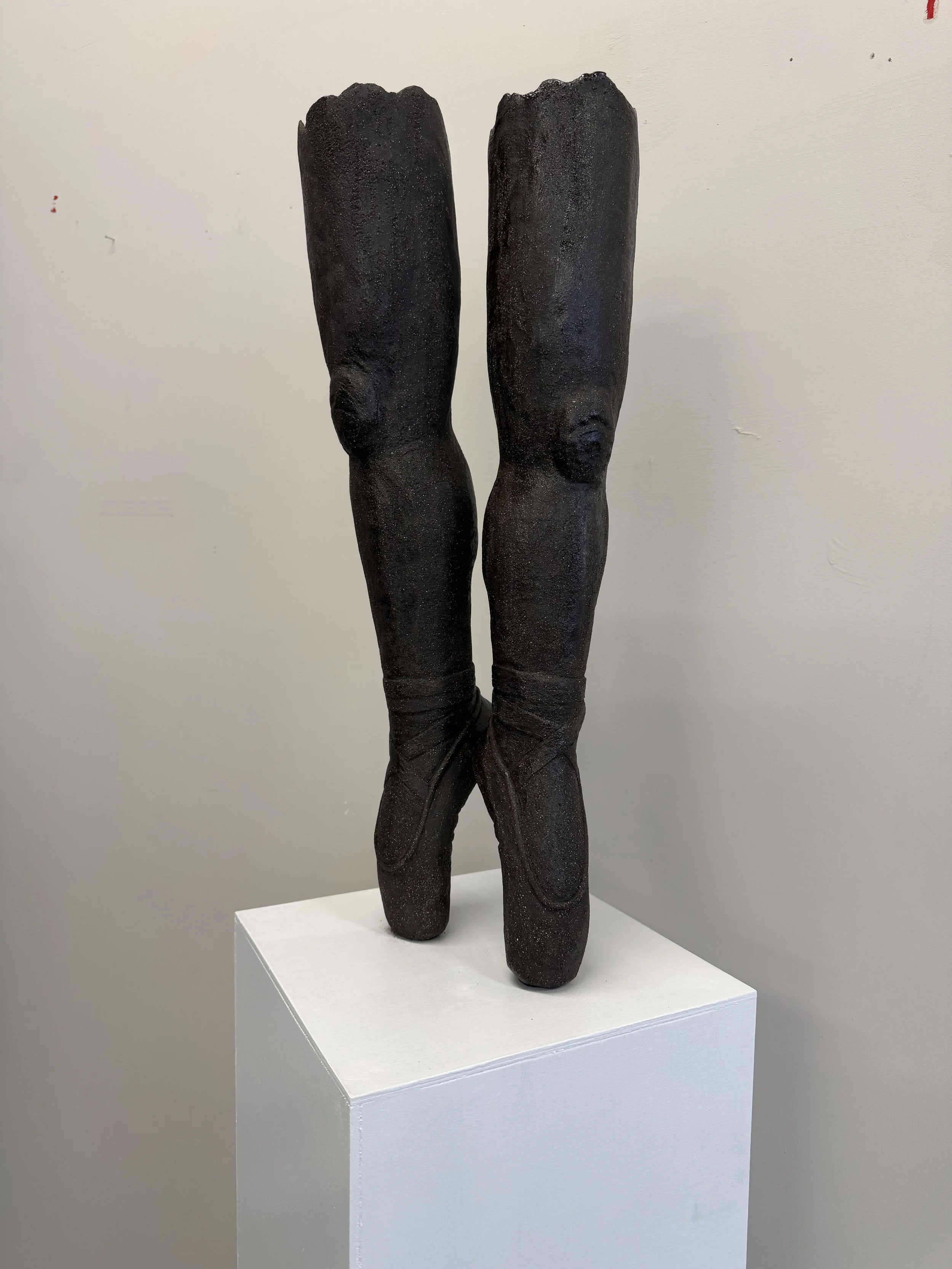
This artwork shows two legs en pointe, without a torso, like a vertical line held by the body’s discipline. The top is cut cleanly, bringing everything back to effort: calves, knees, ankles, and feet alone carry the tension of the pose. There is nothing decorative here; it calls to mind technique, repetition, and the constant pressure required to keep balance.
The dark, matte surface absorbs light and strengthens the sculpture’s physical presence. The volumes are precise, yet never over-smoothed: folds, hollows, small marks, rougher areas recall the hand and the material. This blend of control and visible process echoes training, where mastery is also built through wear.
Within Still Dancing, the work reduces dance to a simple sign: elevation. A body held on the edge of falling, whose fragility becomes presence.
Material: PRNF
Price: €2000 (SOLD)
53h x 15w x 18d
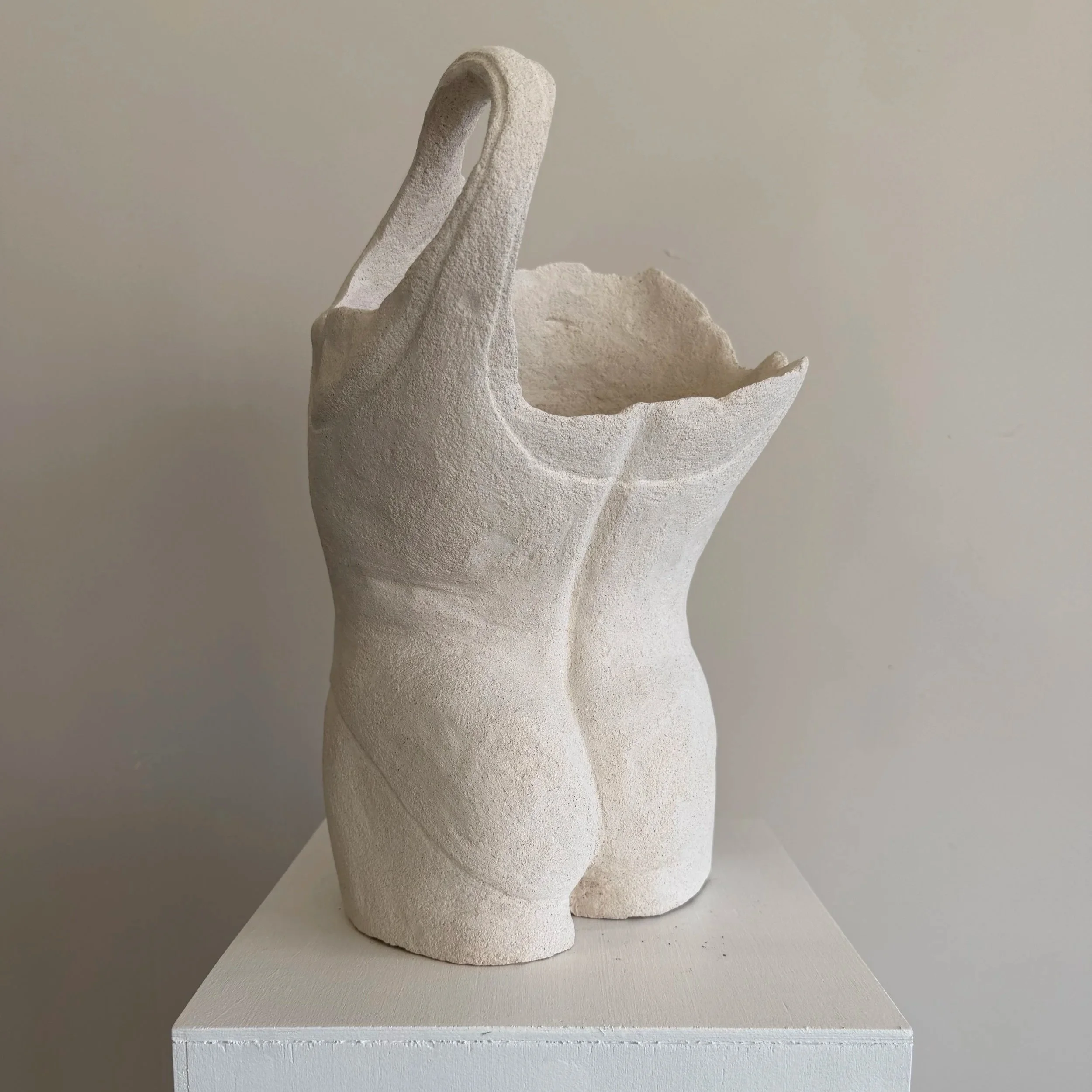
Chyrstyn Fentroy
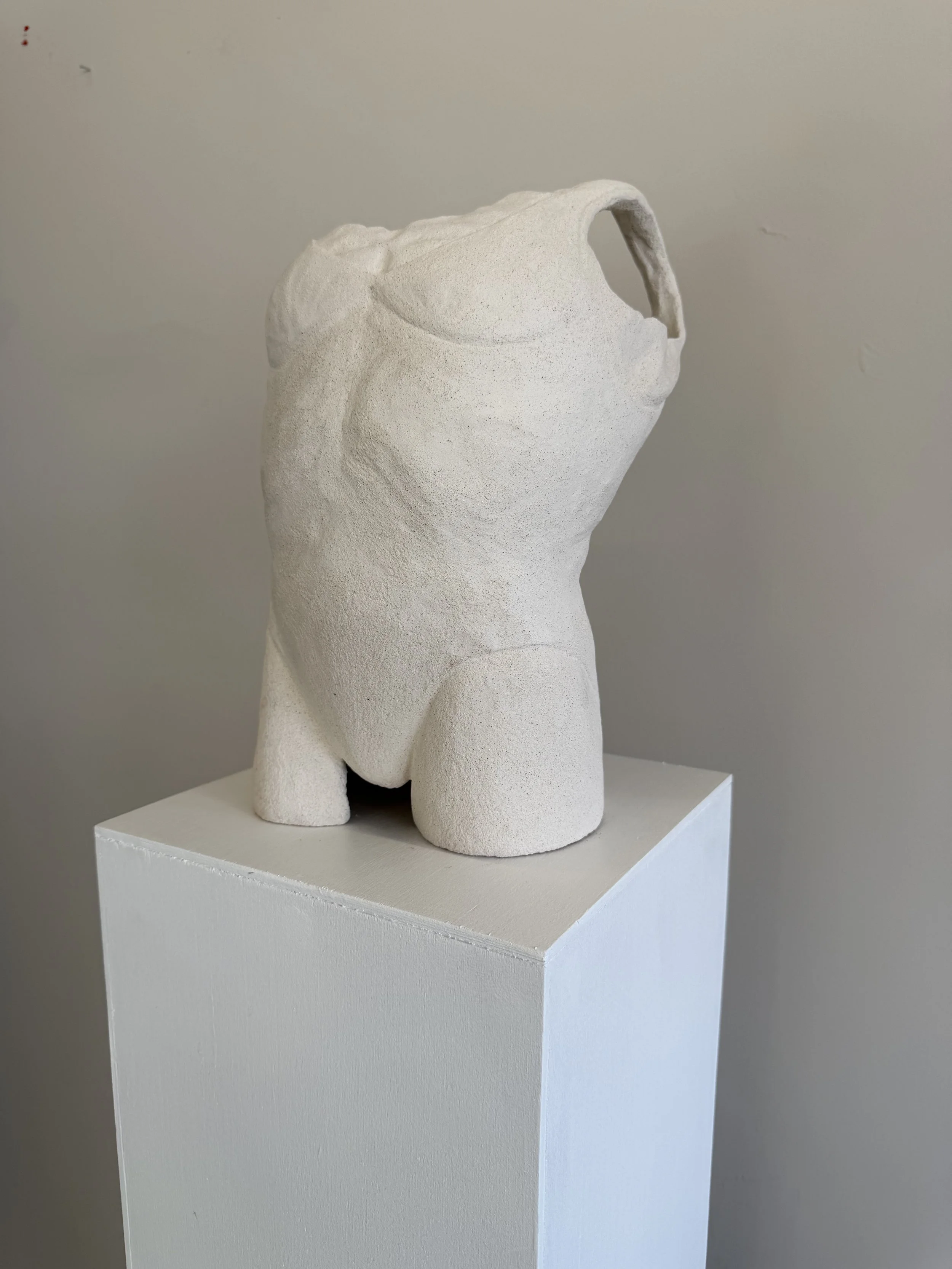
In Chyrstyn Fentroy, the body is reduced to its essentials: a torso, hips, and short legs that seem to rest on an unstable base. The matte white ceramic gently catches the light, drawing the eye upward to the opening at the chest, where a sense of breath appears. The figure is not presented as a whole, but as a living volume, shaped by a subtle tension between grounding and lift.
The sculpture unfolds through a contrast between surface and void. The deliberately raw, irregular edges bring a quiet intensity to the cut, while the curves of the hips and back maintain a continuous softness. In profile, a slight tilt suggests a shift of weight, as if the figure were about to rise or turn. The movement is understated, yet unmistakable.
Here, incompleteness becomes a source of presence. Without head or arms, attention moves toward breath and balance. The work invites a slow gaze, attentive to the nuances of its ceramic skin, offering a fragile yet enduring presence, a suspended gesture that continues to resonate.
Material: PRAF
Price: €1600
31h x 21w x 20d
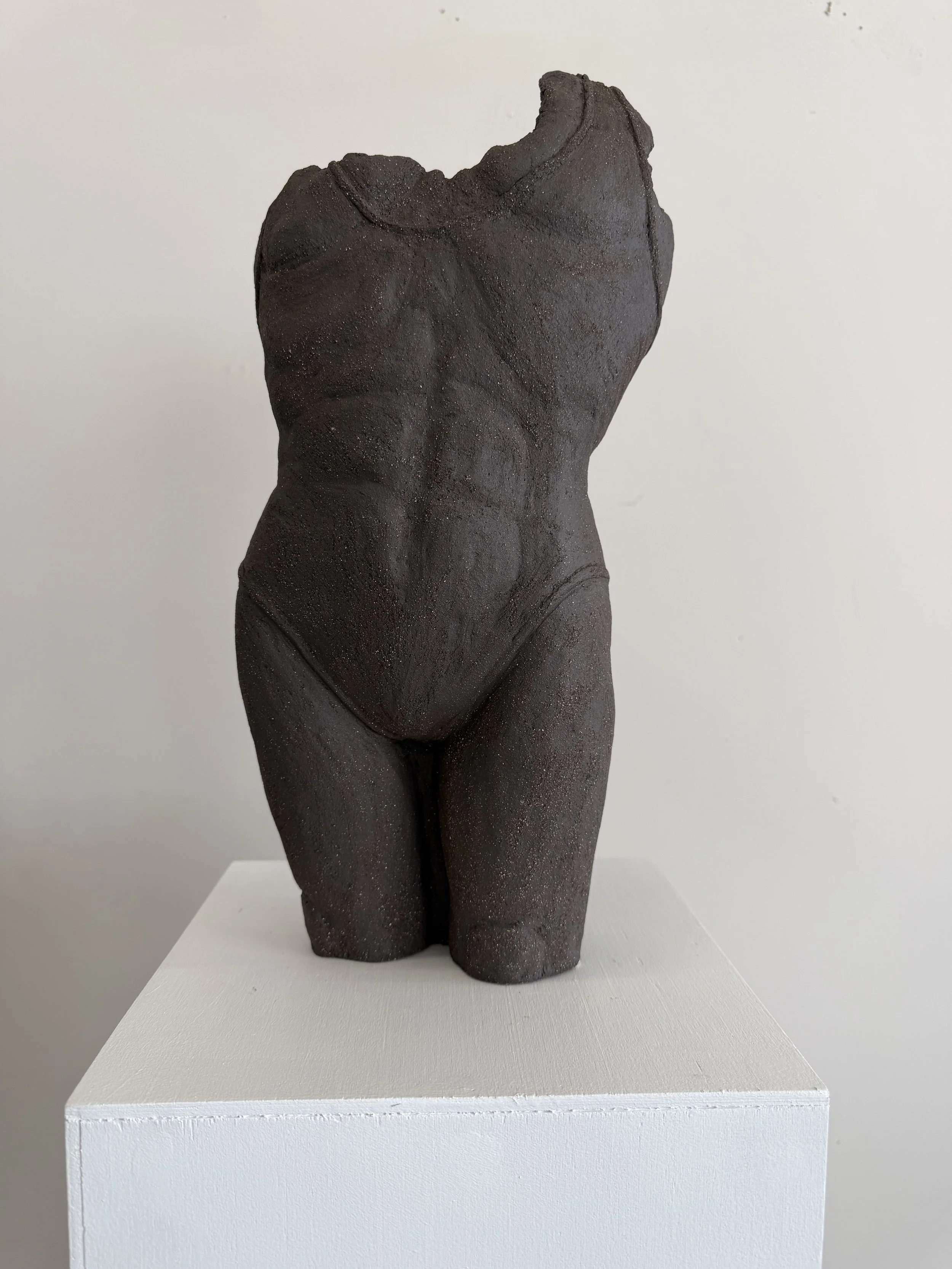
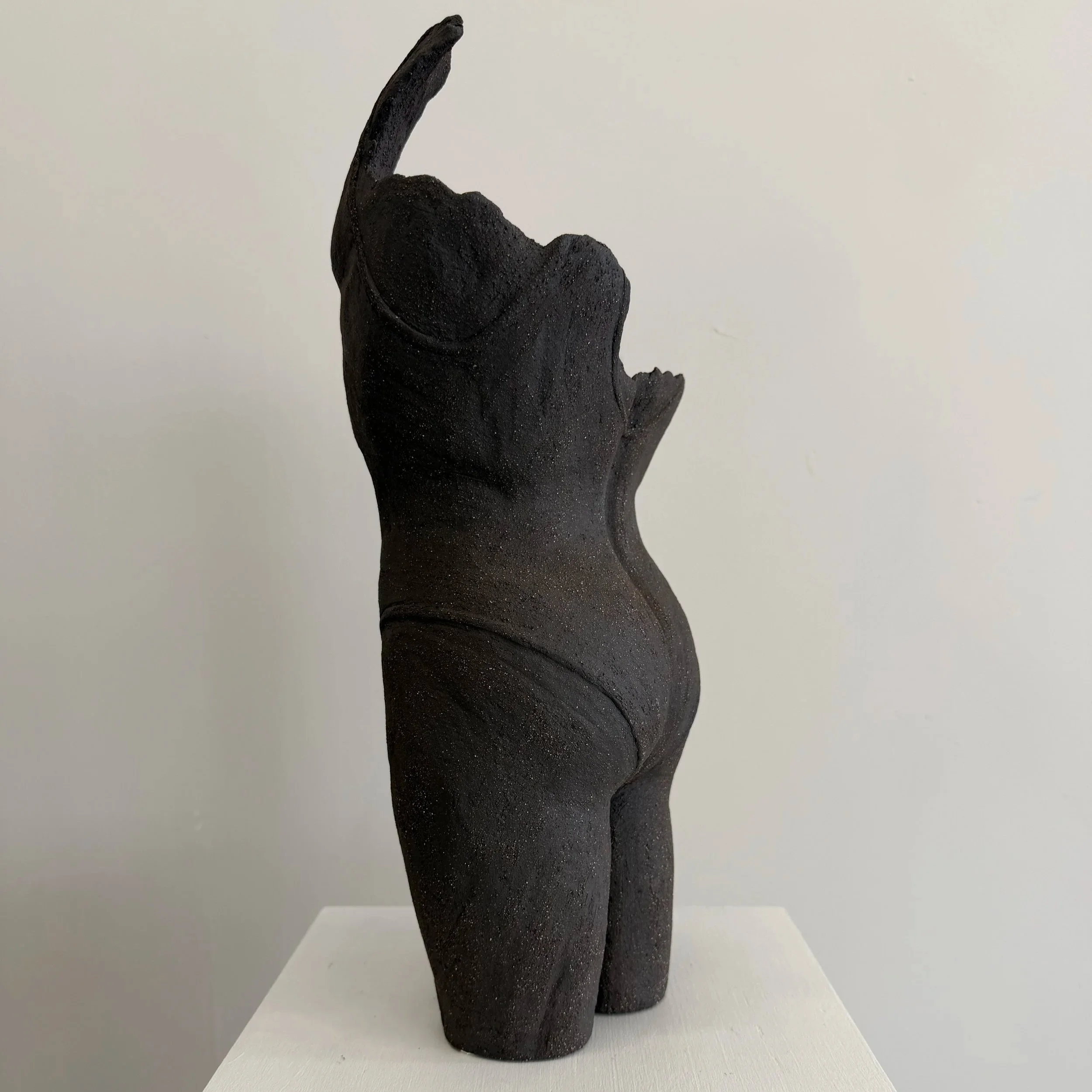
Courtney Lavine
This artwork shows a female torso without head or arms, cut off just above the thighs, like a presence that stands on its own. The top is irregularly cut, giving the sense of a gesture stopped short: movement is no longer visible, yet it remains felt in slight twists, the curve of the abdomen, the tension of the hips. Nothing is idealised here, the figure is compact, gathered, and balance is read through small shifts, like a recovered footing.
The dark, matte surface absorbs light and reinforces the density of the volume. Details are not ornamental: they appear as striations, folds, pressures, “seams” in the material that retain the memory of the hand and the firing. The texture suggests a worked skin, almost textile, while the form stays tightly held.
Within Still Dancing, the work brings dance back to an inner sensation: breath, hold, resistance. A body that is vulnerable yet solid, poised on the edge of movement.
Material: PRNF
Price: €1700 (SOLD)
38h x 18w x 15d
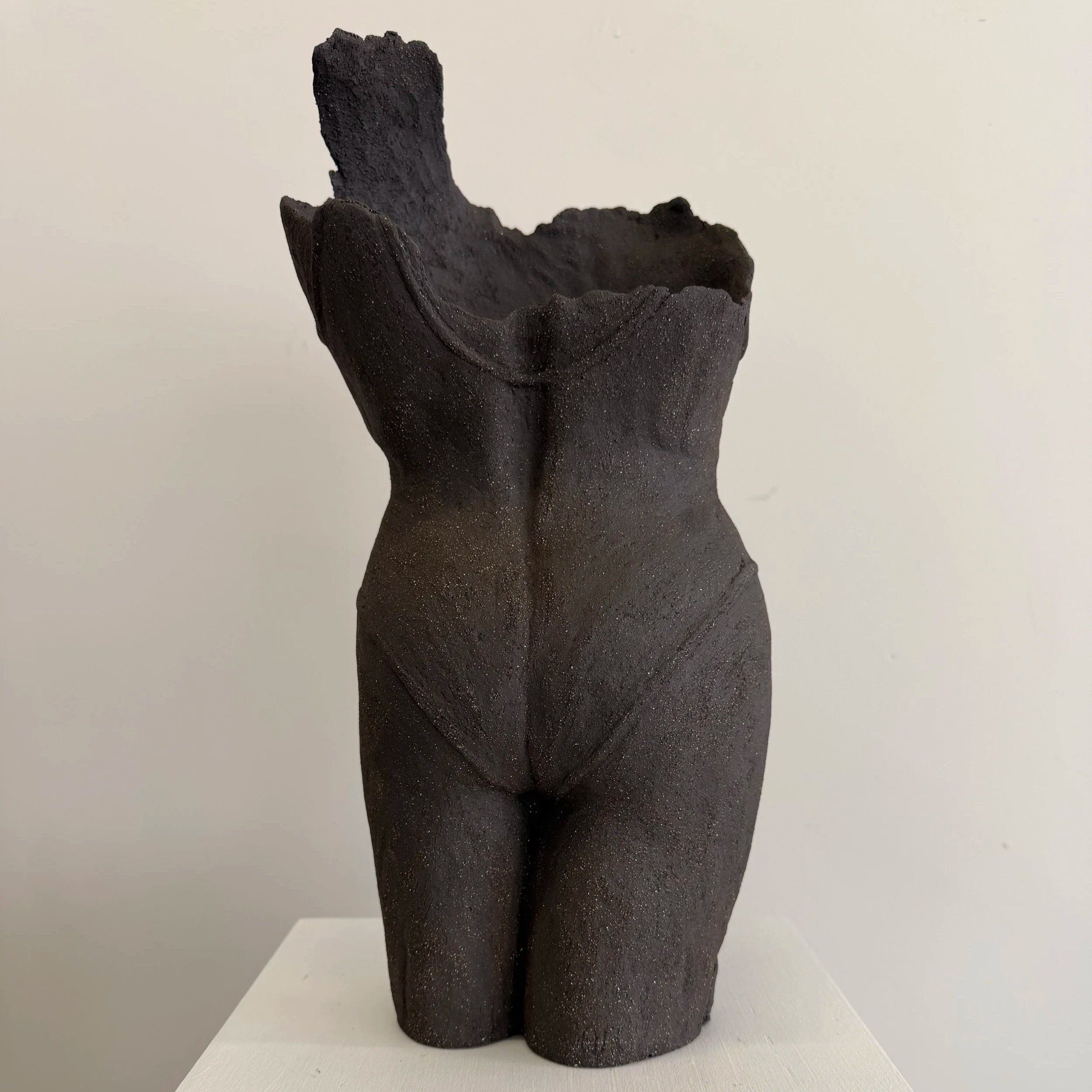
Carlota
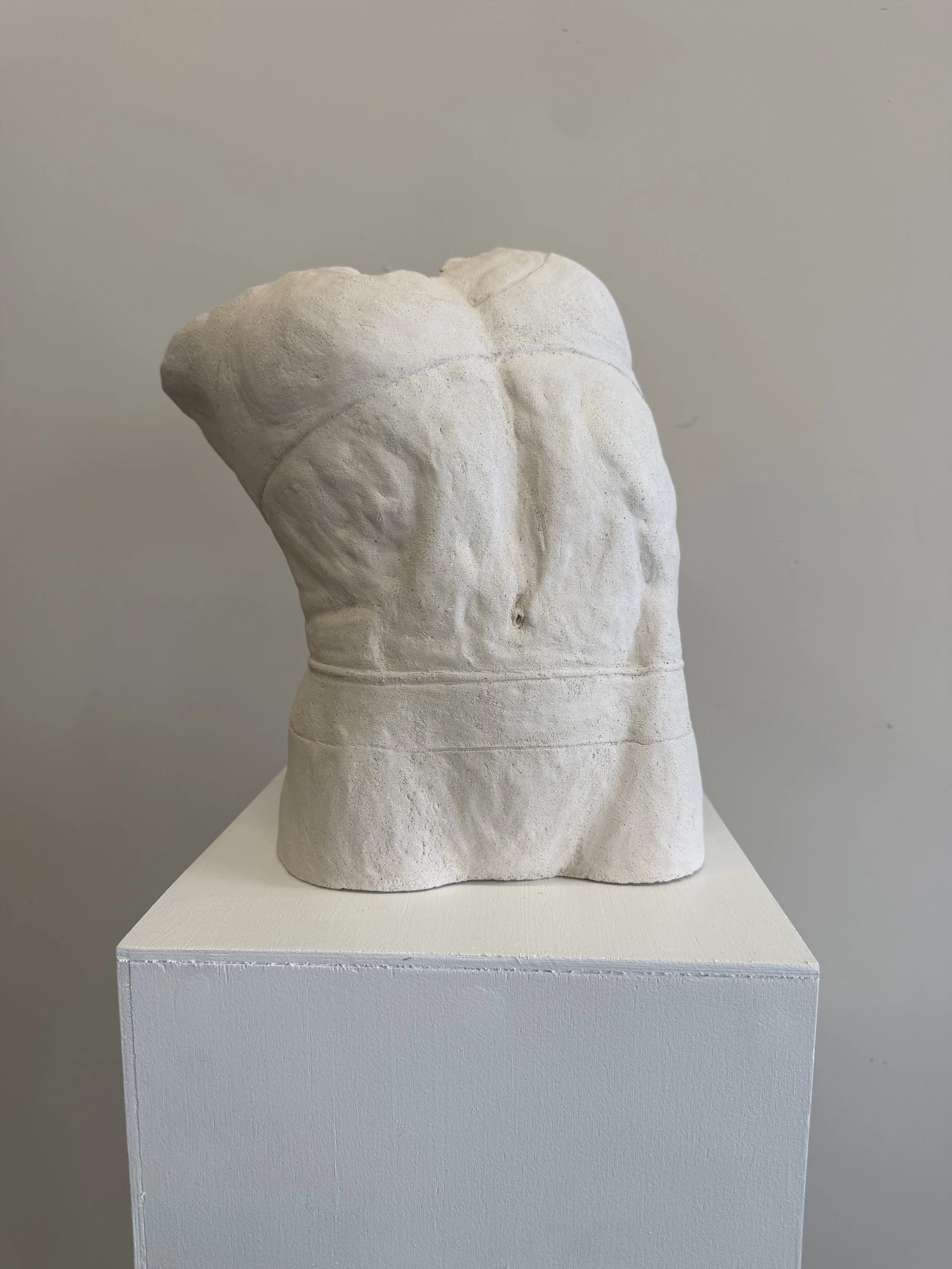
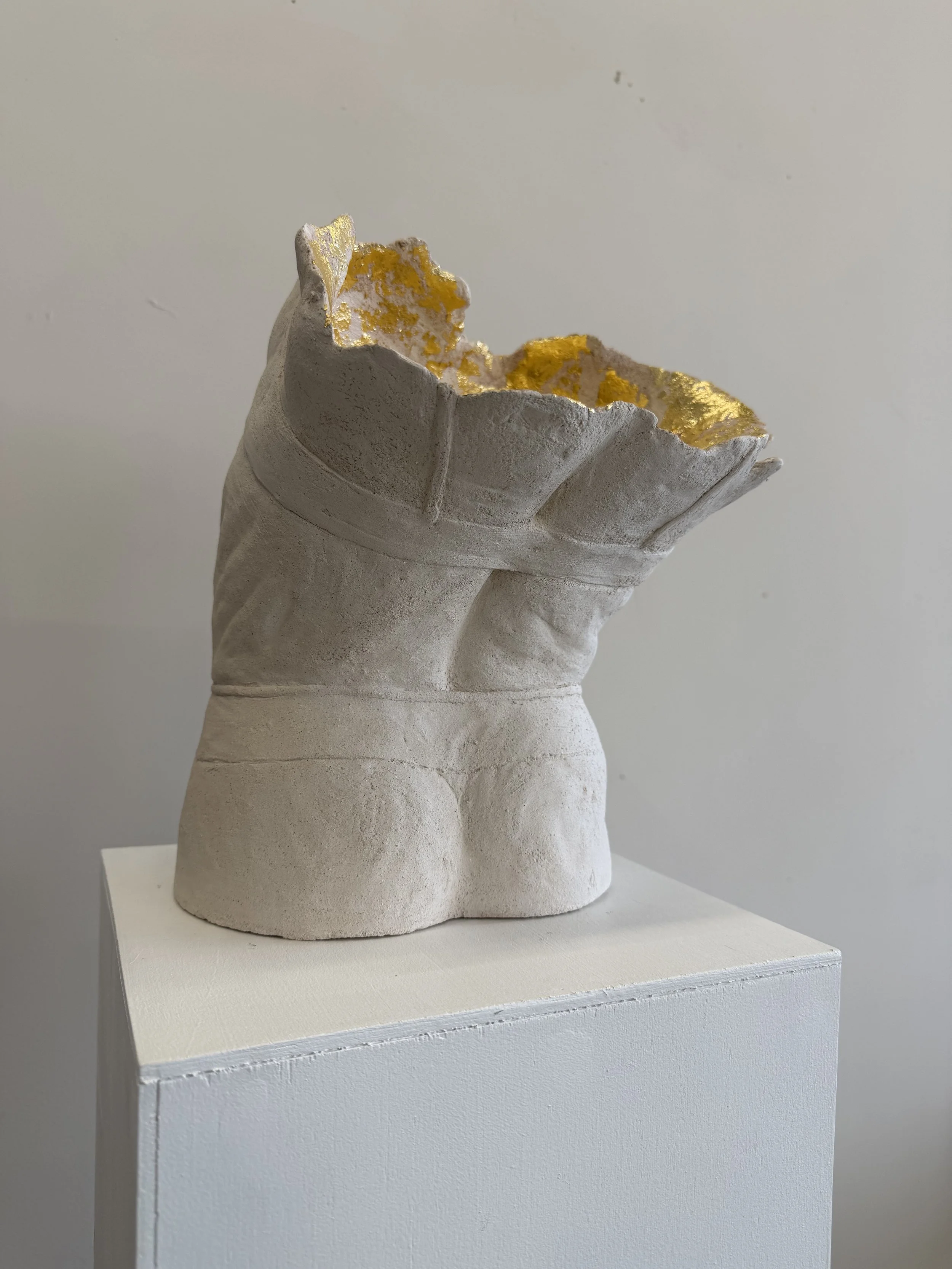
In Carlota, the body is reduced to the bust, held in a delicate balance between steadiness and shift. The matte white ceramic gently catches the light, revealing a compact, cinched volume where anatomy is simplified yet deeply expressive. The figure appears slightly off-center, as if the weight were moving from one support to another. The movement is not declared; it remains internal and restrained.
The sculpture unfolds through a tension between continuity and rupture. Folds and surface depressions suggest material shaped by pressure, a rhythm of holding and release. At the top, however, the form breaks abruptly. The irregular opening is lined with gold. This gilding is not decorative; it highlights the fracture, turning it into a point of illumination.
In a spirit akin to kintsugi, the break becomes structure. The gold draws the eye inward, toward what has been broken and acknowledged. Repair becomes an act of composition. The work invites sustained attention, where restraint and radiance coexist, as if emotion found its form at the very edge of rupture.
Material: PRAF
Price: €1700
30h x 25w x 20d
Pointed shoes on “marble stone”
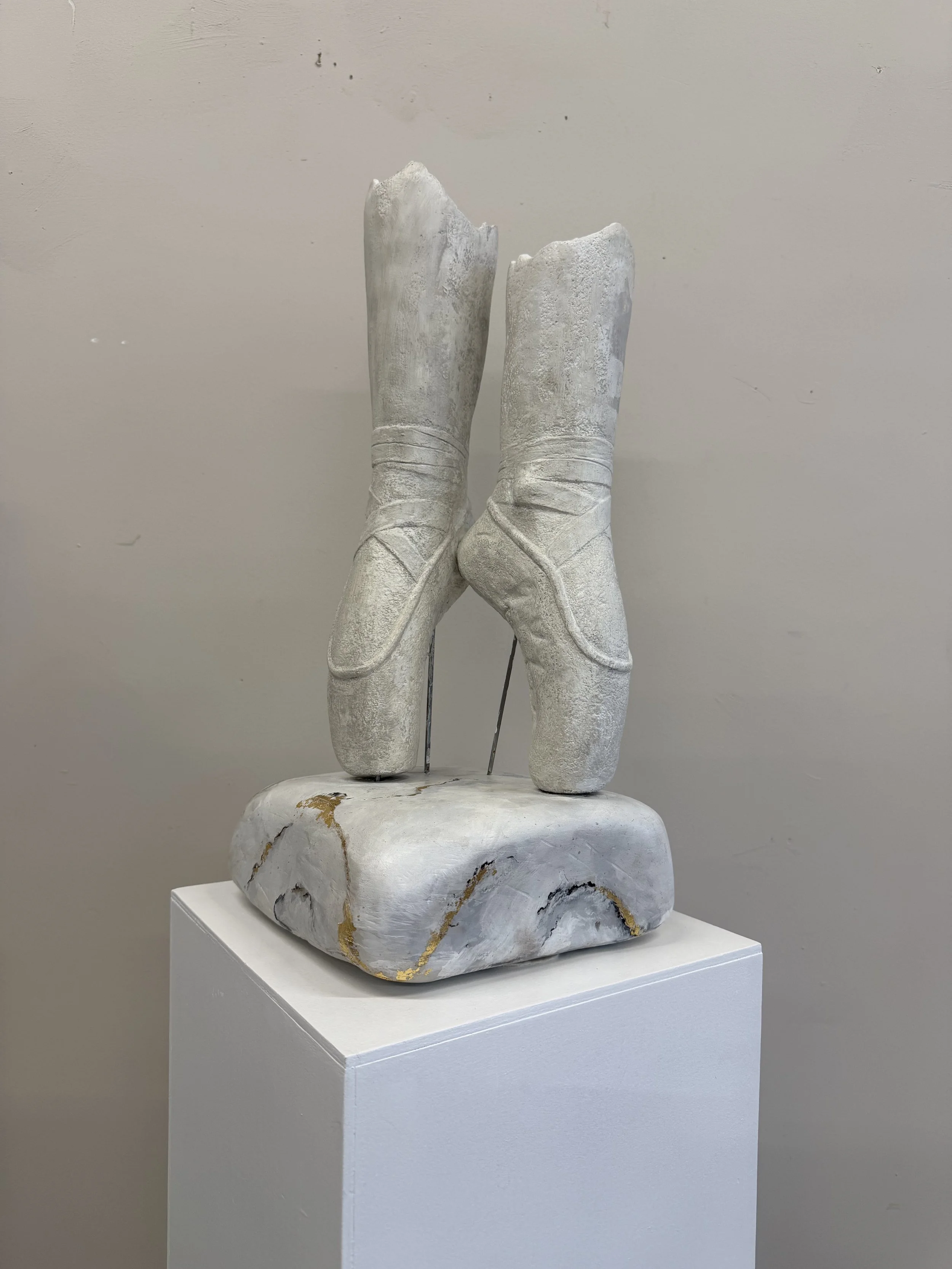
This artwork shows two lower legs in pointe shoes, set upright on a block that evokes a marble stone. Everything hinges on the relationship between elevation and weight: the pointes speak of discipline, held posture, sustained effort, while the heavy, cracked base recalls what resists, the ground, matter, the real. The blunt cut at the top of the legs marks an intentional interruption, as if the artist had lifted a moment from dance and turned it into a sign.
The pale surface, painted and varnished on unfired ceramic, gives the ensemble an almost chalky fragility; light brings out small variations and traces of work. The “marble” retains breaks and repairs, accented with touches of gold: the accident isn’t erased, it becomes readable, and the base takes on the value of memory.
Within Still Dancing, the work reduces dance to a simple dialogue: standing upright, and holding, despite everything.
Material: PRAF
Price: €1500 (SOLD)
44h x 18w x 18d
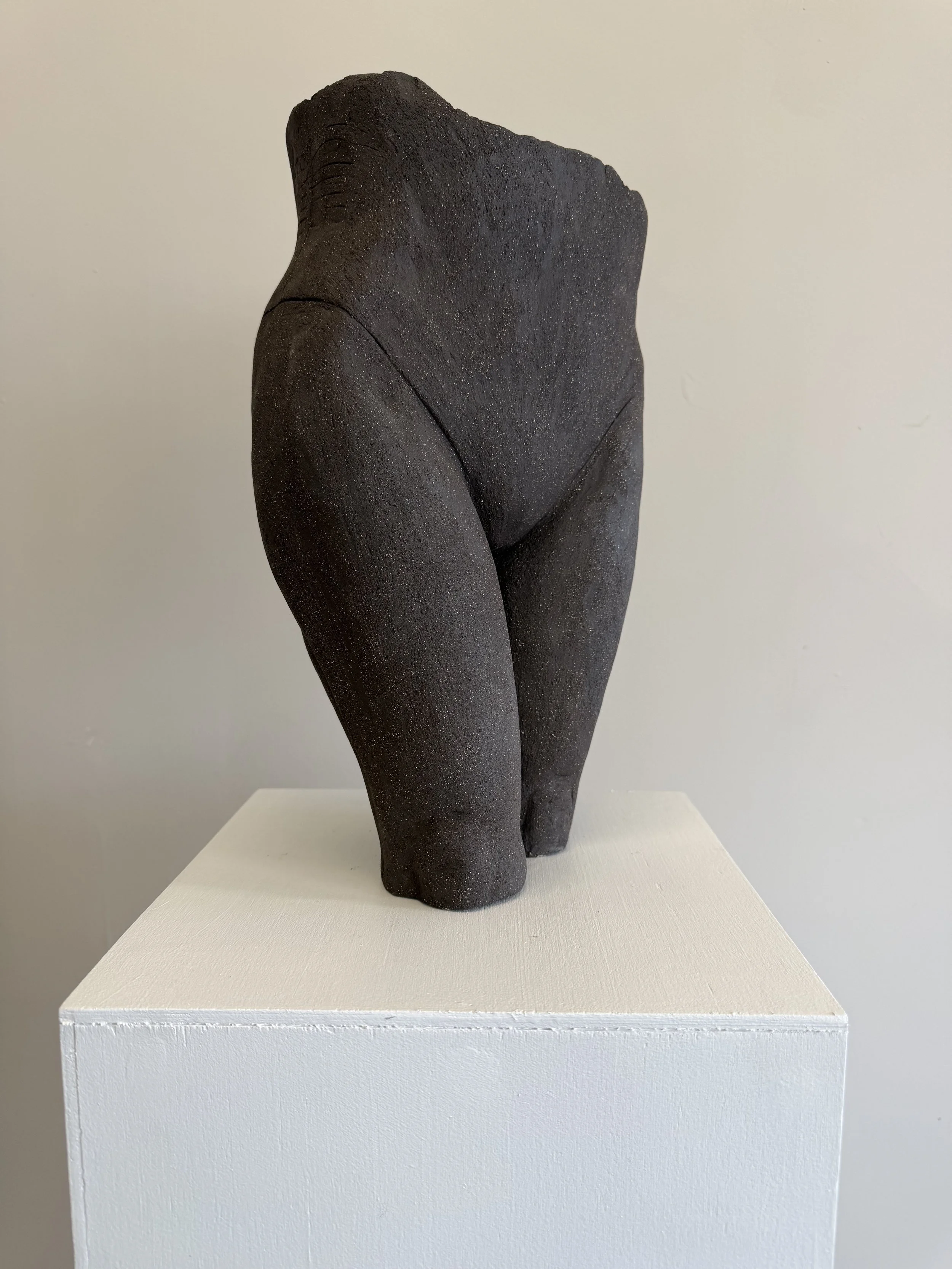
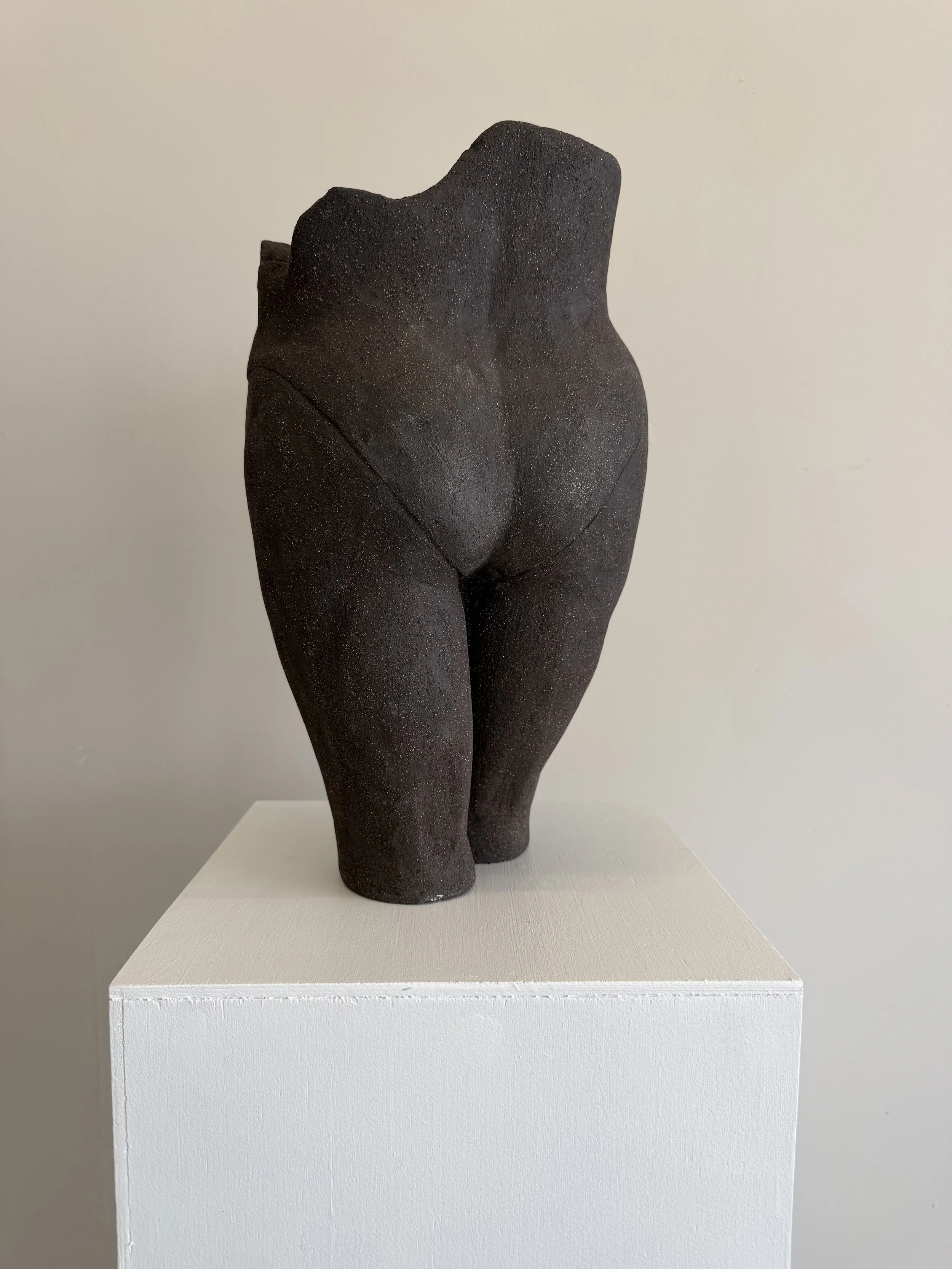
In Twyla Tharp, the body is concentrated around the pelvis and legs, as if the dance had been framed at its point of origin. Without head or arms, the figure stands in a dense, slightly off-center verticality where everything seems to arise from weight. The black surface absorbs rather than reflects light, giving the volume a compact, focused presence, like a body about to shift its balance.
Nothing is theatrical, yet movement is unmistakably there. The line of the hips, the tension of the thighs, the subtle curve suggest an inner rotation, a suspended transition. A contained rhythm emerges, an alternation of tension and release, as if the gesture still persisted beneath the material. Slight asymmetries and variations in texture sustain this vibration: the stillness is never inert.
The work speaks of controlled energy, of a dance held close to its axis. The fragment is enough. It gathers the whole body and reveals its quiet strength.
Material: PRNF
Price: €1600
33h x 19w x 18d
Twyla Tharp
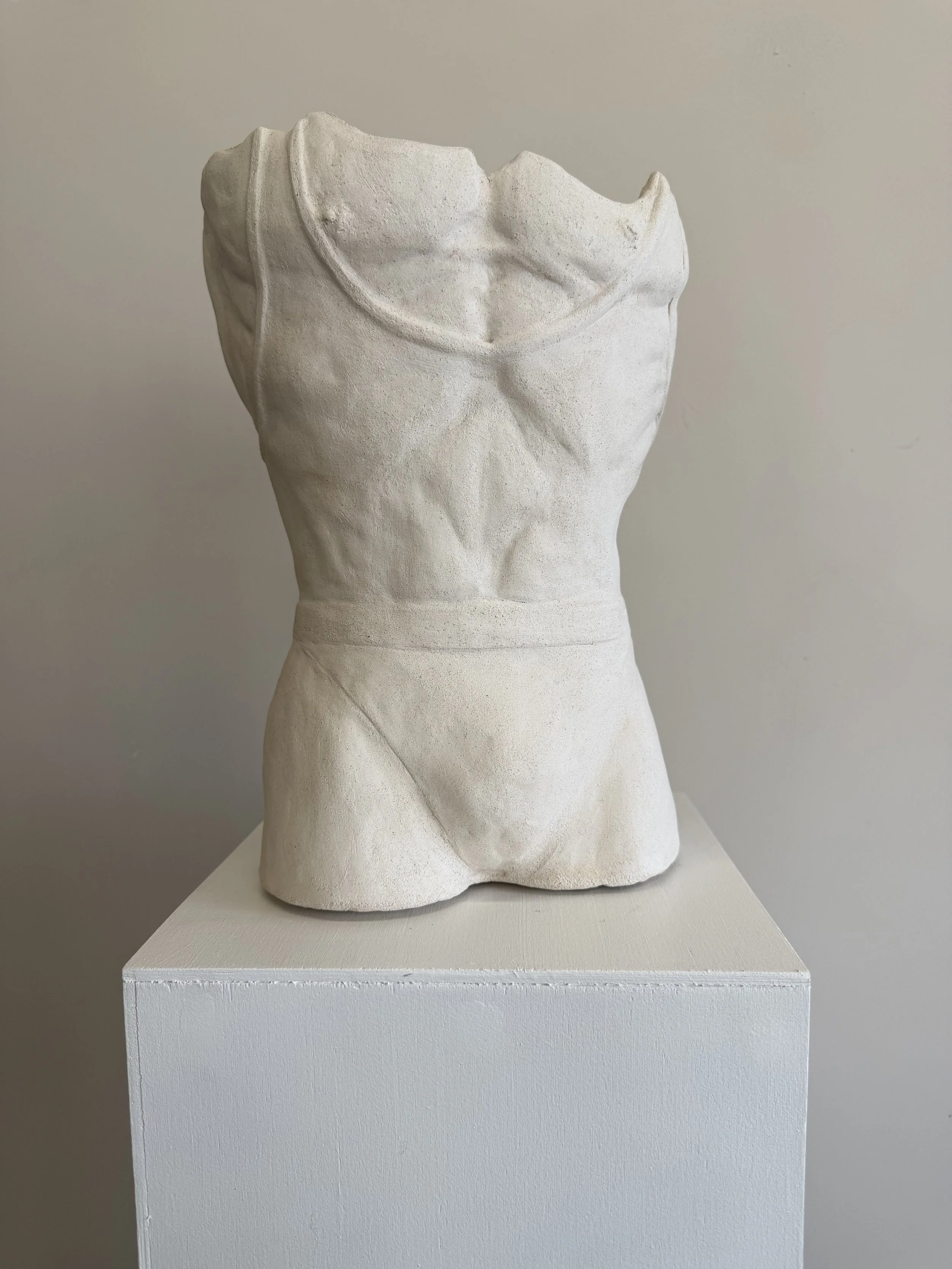
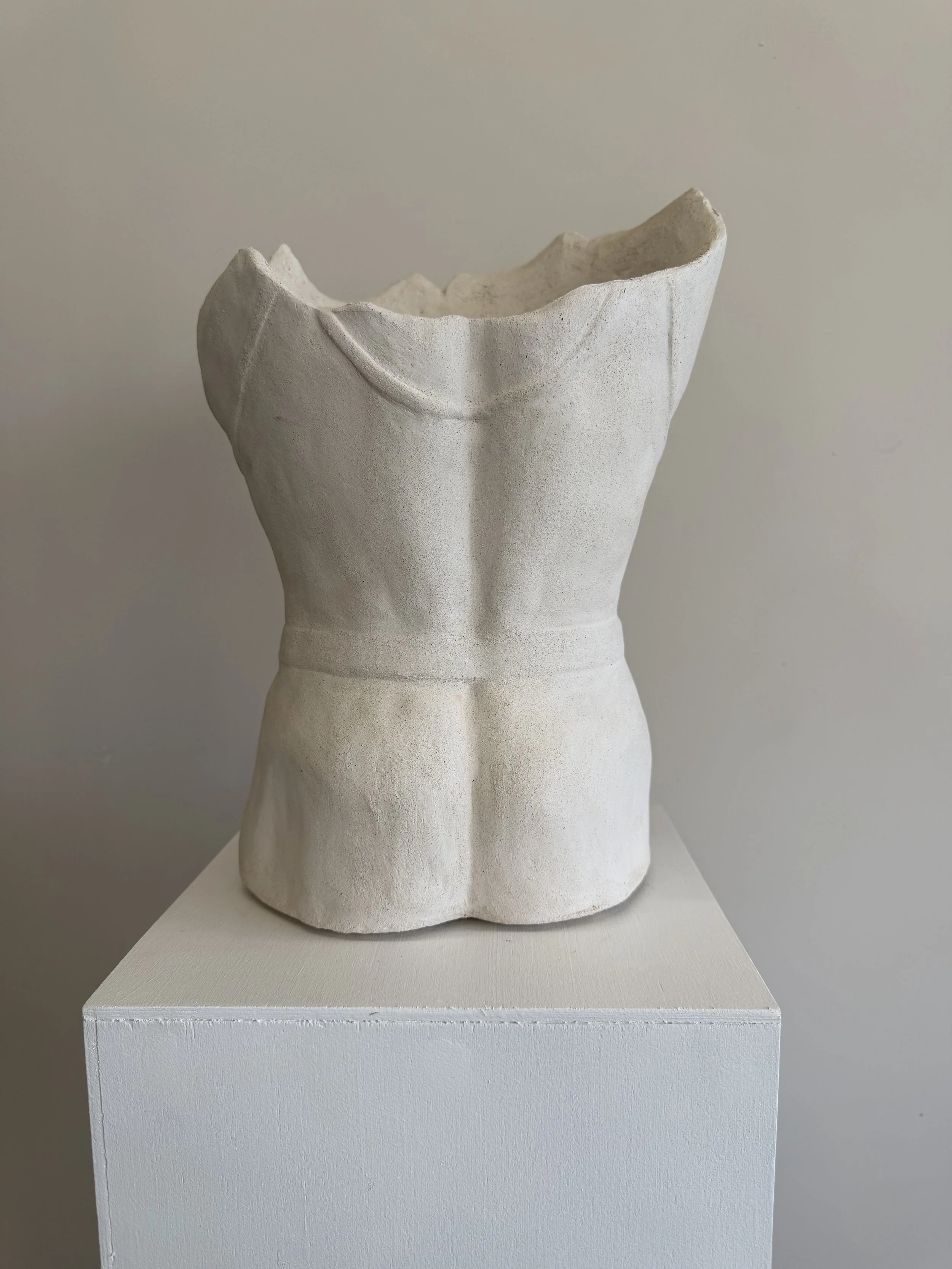
This artwork presents a fragmented torso, poised on the line between clothing and anatomy. Without head or arms, everything concentrates on the ribcage, waist, and pelvis, where breath, posture, and muscular tension become visible. A line running across the upper torso suggests a drape or a strap, as if the body retained the memory of a movement or a stance.
The top, irregularly cut, is not concealed. It reminds us that the object was made, broken, and then taken up again, and that it speaks of an interrupted motion rather than a “finished” form. The matte white surface drinks in the light and highlights the micro-reliefs of modelling: folds, hollows, pressures, traces of the hand.
The sculpture thus asserts a compact, almost silent presence. Dance is not narrated; it is sensed in the body’s held posture, and in what is missing as much as in what remains.
Material: PRAF
Price: €1800
33h x 23w x 18d
Zarely
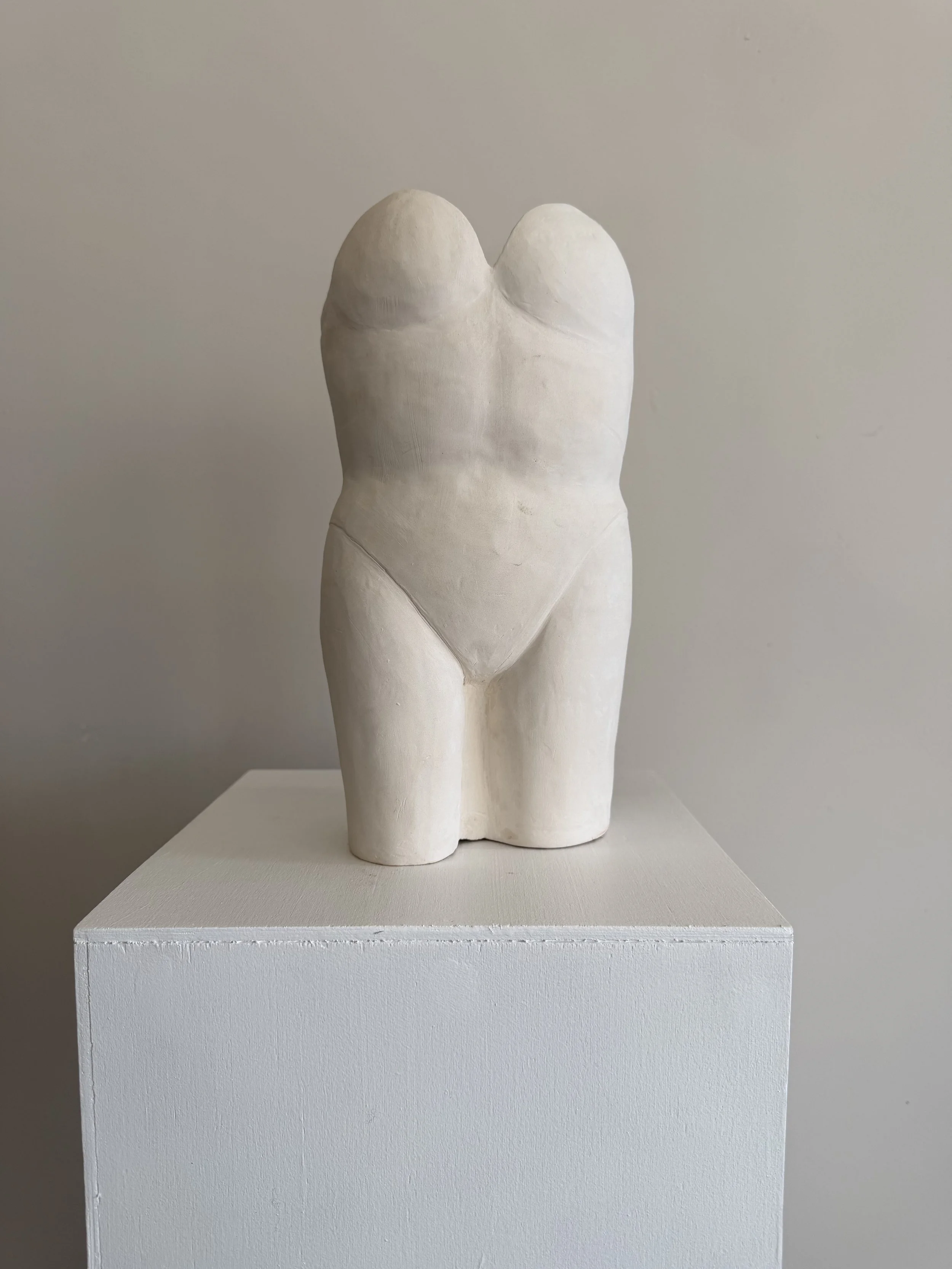
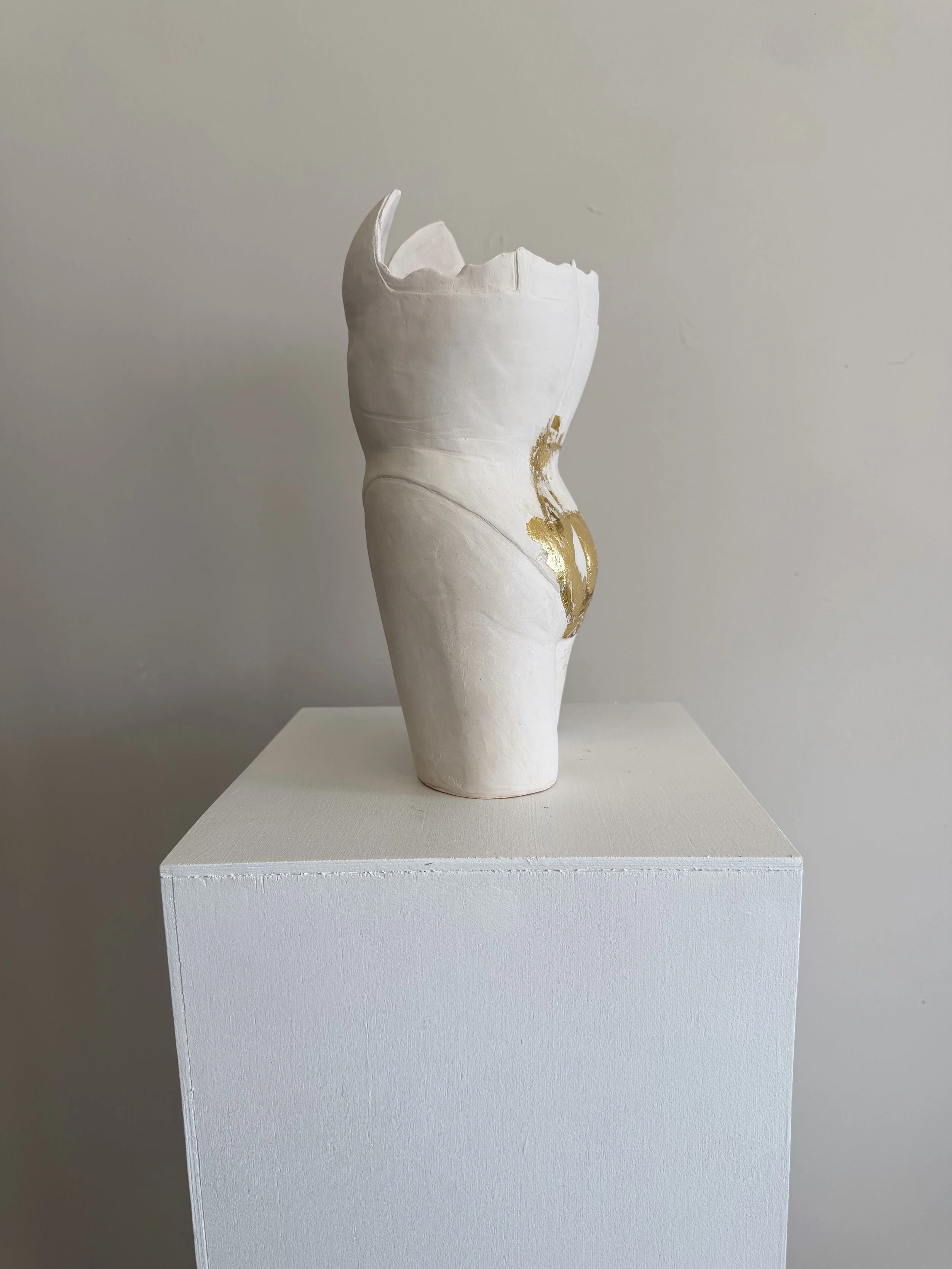
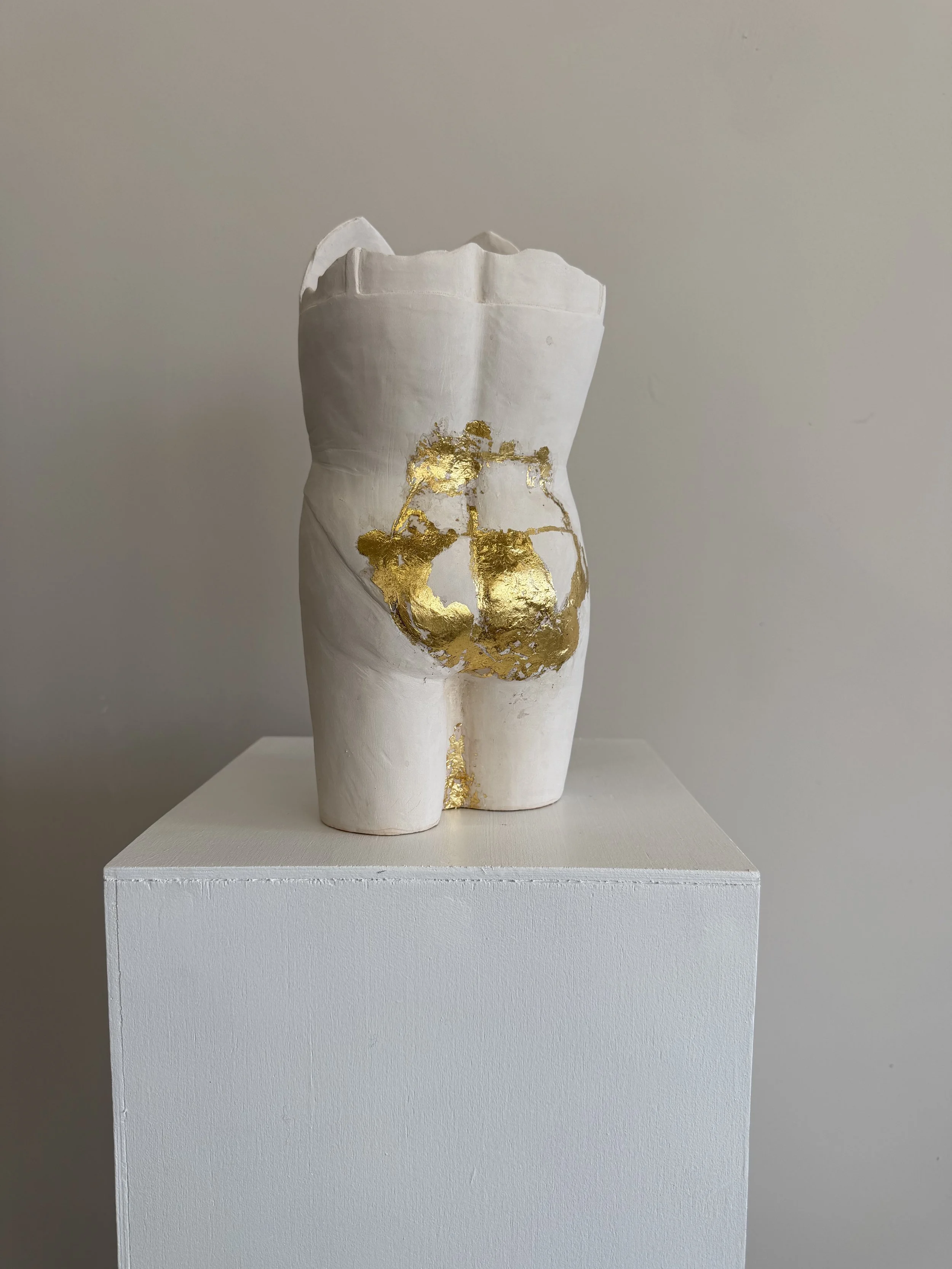
In Maiko Nishimo, the body is reduced to the bust and hips, like a figure suspended just before becoming narrative. The matte white ceramic catches a soft light, giving the volume a calm, almost silent presence. The anatomy is deliberately pared down, frontal, axial, held. This reduction does not diminish the body; it concentrates it, as if the dance were distilled into a single essential posture.
The sculpture unfolds through a clear contrast between continuity and rupture. The break at the top remains visible and unapologetic. It opens the form, introduces vulnerability, and shifts attention to the surface. In profile and from behind, a golden repair runs across the body, redefining the line of the lower back and hips. The gold does not decorate; it records time, marking the memory of an event.
In a spirit akin to kintsugi, the fracture becomes structure. The white suggests intimacy; the gold affirms the moment of rupture. Repair becomes a compositional gesture, guiding the gaze like movement returning after pause. The work invites slow attention, where softness and break coexist in quiet balance.
Material: PRAI with Kintsugi
Price: €1500 (SOLD)
29h x 14w x 11d
Maiko Nishimo
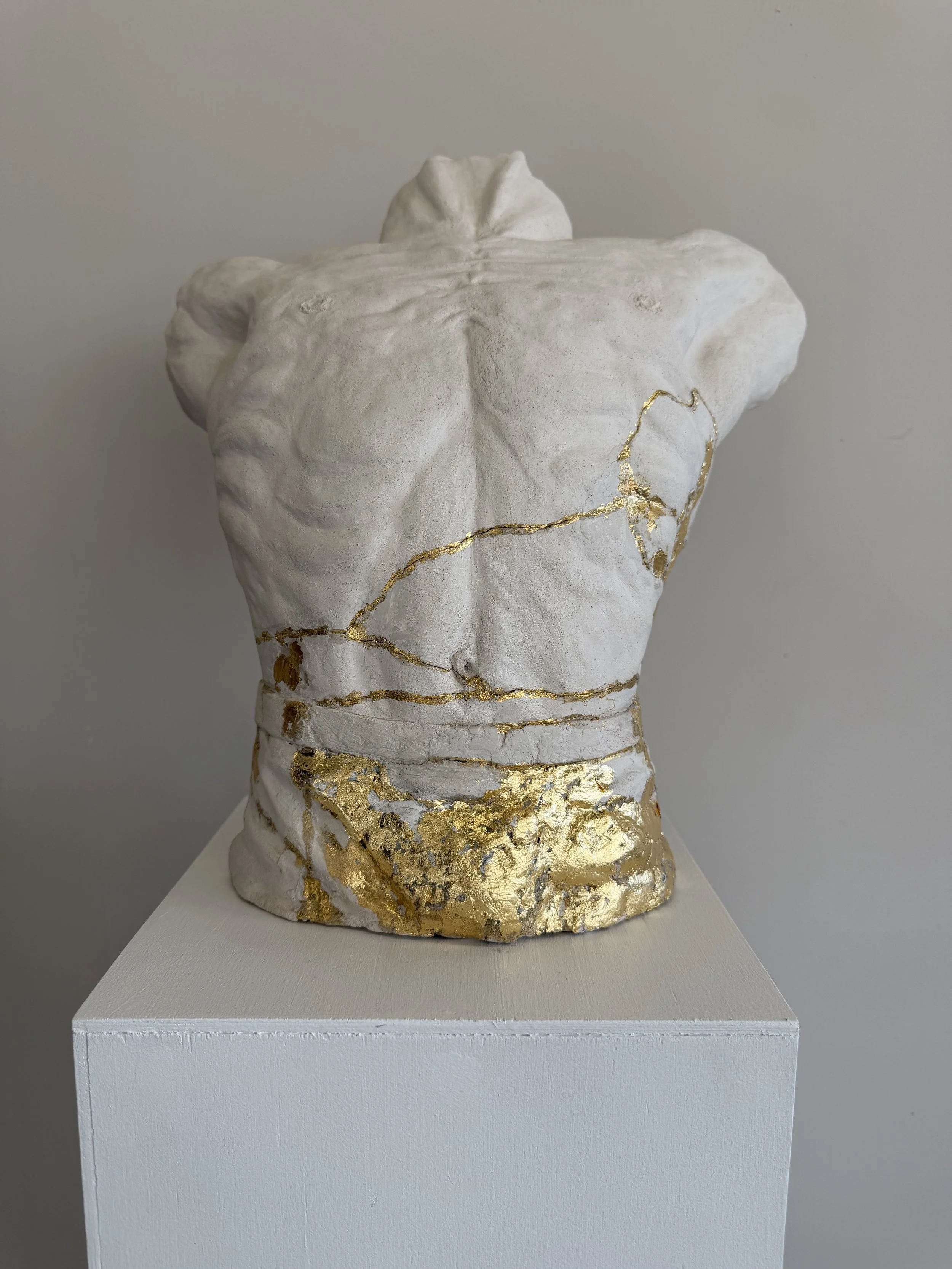
This artwork shows a powerful torso, cut at the neck and widely opened at the back. The form flares like a corolla and sits in tension between two readings: a very real body, mass of the chest, tightened waist, and the idea of a “costume”, almost a kind of armour. The fragmentation isn’t theatrical; it mainly shifts attention to what allows the body to hold, breath and contained energy.
Kintsugi is central. A fracture runs through the piece and extends into a broad gold area at the base: the repair becomes a line of force, structure, light. The gold doesn’t hide the accident; it makes it visible and gives it a role. The sculpture reads as an object tested and then reinforced.
The work evokes what comes after the gesture: effort, rupture, recovery. Dance appears here less as virtuosity than as endurance, a body that holds because it accepts its own scars.
Material: PRAF with Kintsugi
Price: €2000
36h x 36w x 21d
Matthew Bourne
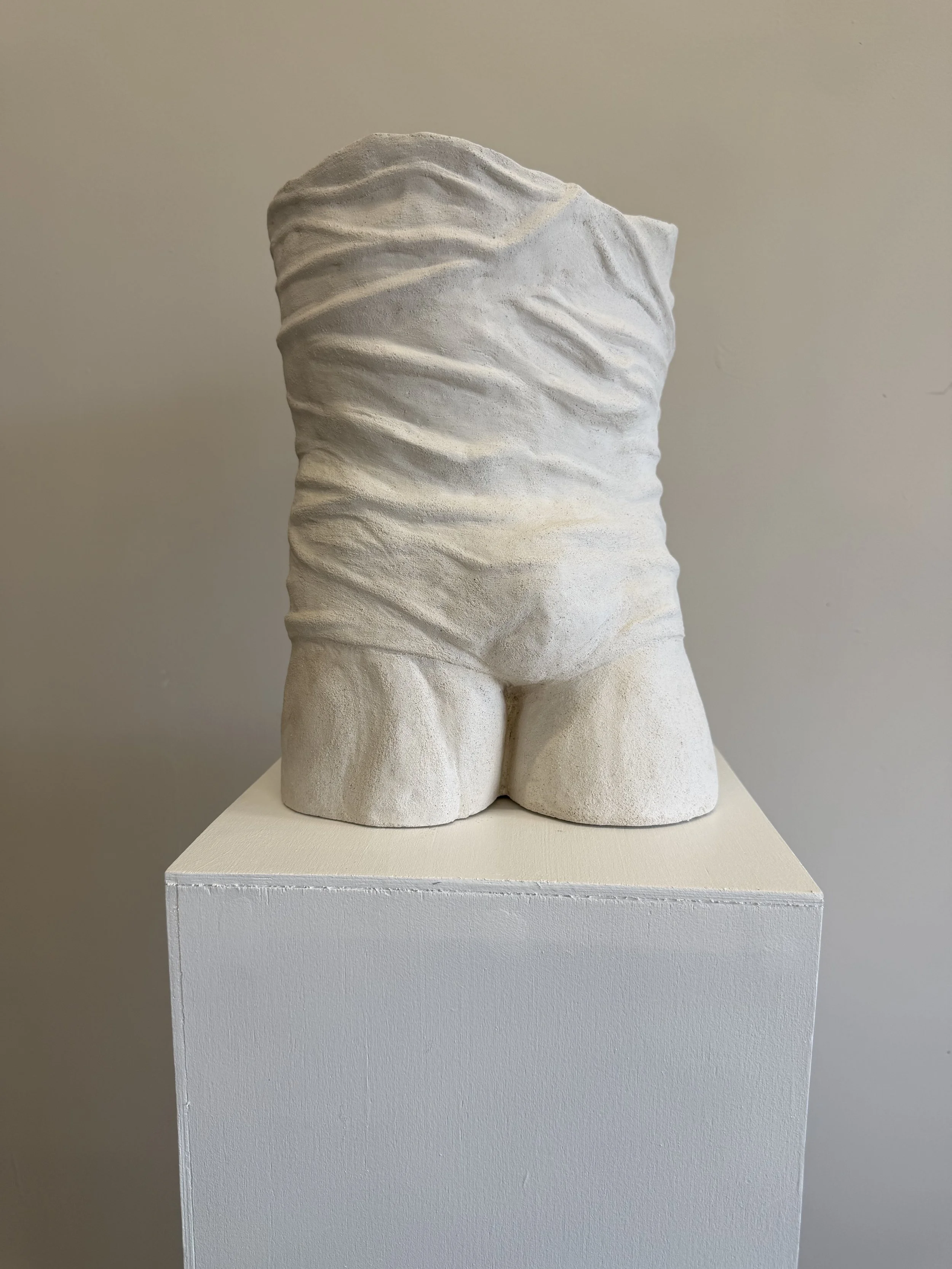
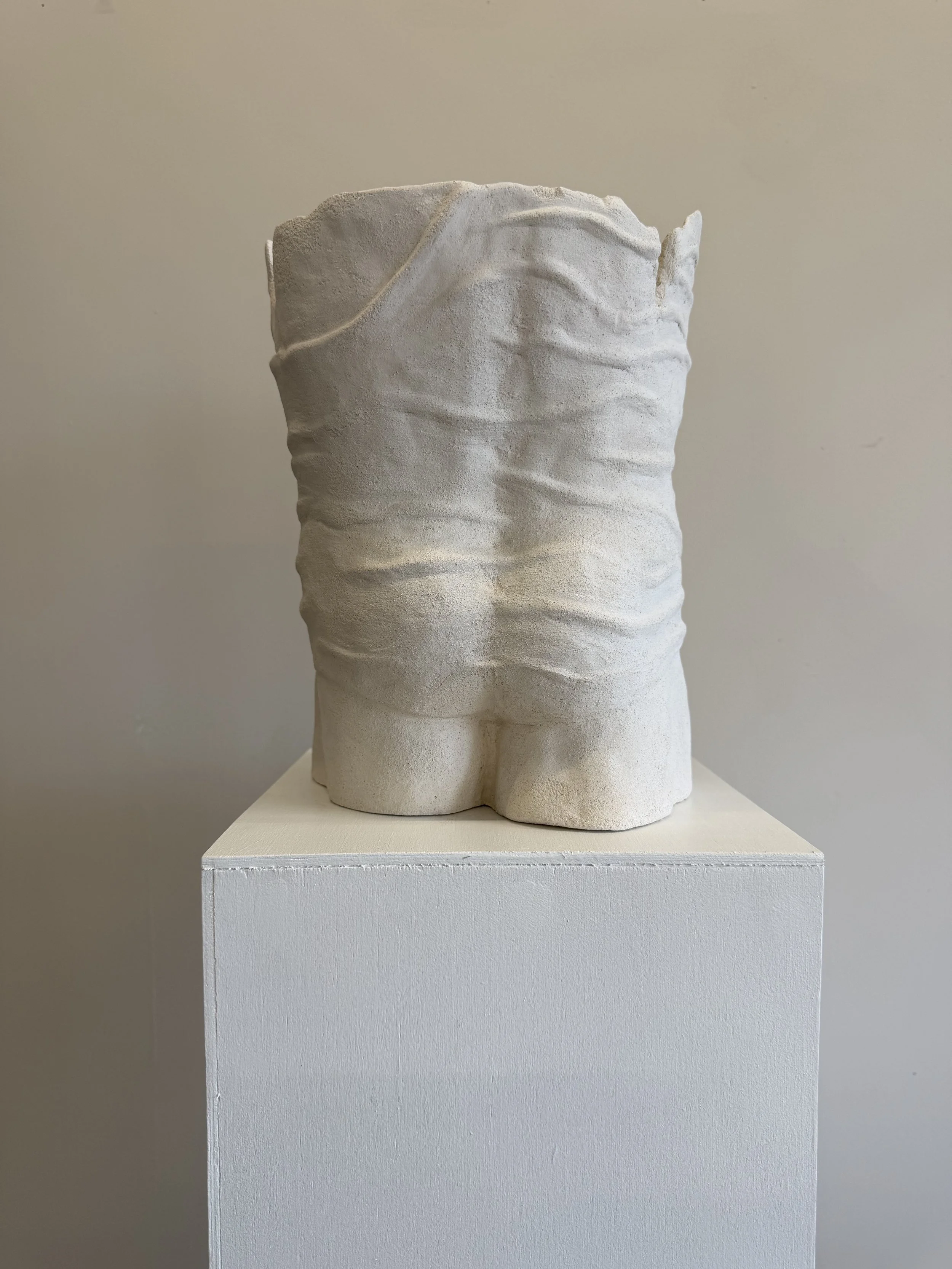
In Ronde Pointe (Love Chapter 2), the body is condensed into a shortened bust set upon tightly joined legs, as if resting after exertion. The pale ceramic gently catches the light, presenting the form as an enveloped volume rather than a described anatomy. What emerges is not musculature but a sense of skin, fabric, and contact. The body feels folded inward, intimate and unassertive.
The surface is built in layered folds, recalling drapery or bandaging. These strata guide the eye and suggest a gesture of tightening, holding, perhaps protecting. From front and back, the undulations subtly shift the perception of volume, creating a soft oscillation between presence and withdrawal. Movement is not shown; it lingers in the memory of tension.
The work reflects on the ambivalence of embrace: to wrap can mean to care as much as to contain. The fragment becomes a space of contained emotion, favoring closeness over spectacle. The sculpture invites sustained attention to its surface nuances, proposing love as a quiet choreography of pressure, breath, and support.
Material: PRAF
Price: €1700
29h x 21w x 18d
Ronde Pointe (Love Chapter 2)
Sol Leon
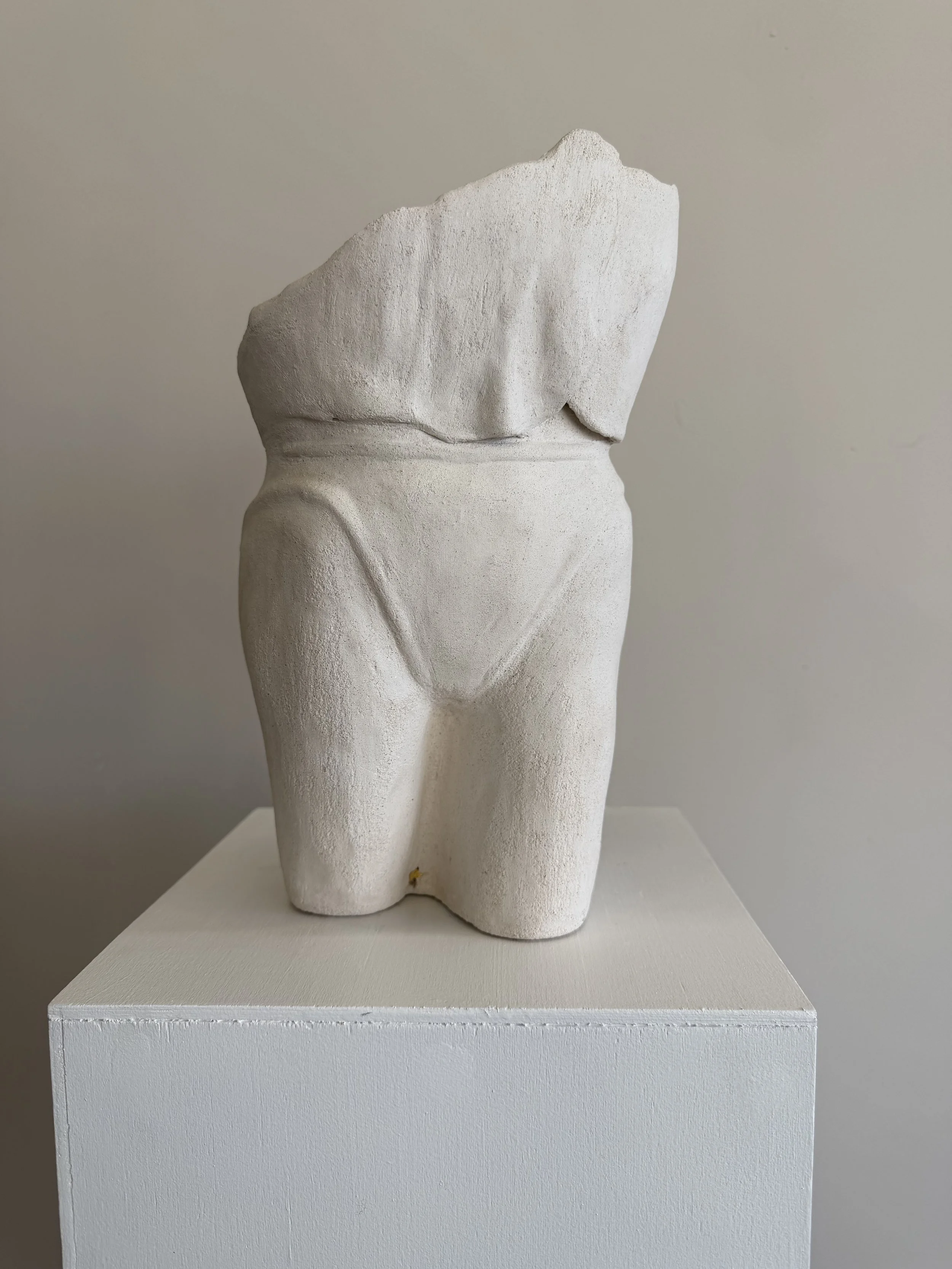
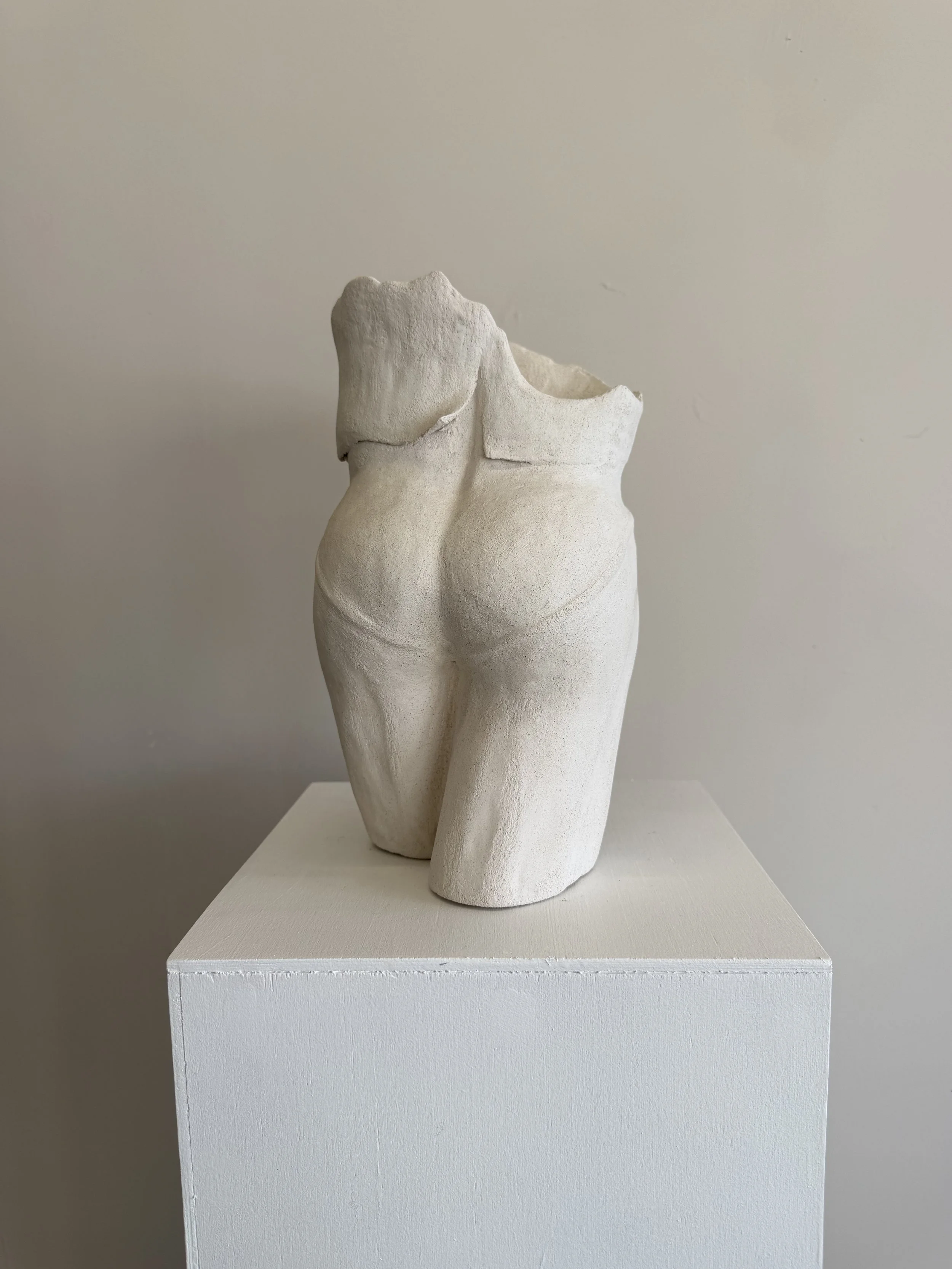
This artwork shows a fragment of a body: the pelvis and thighs, topped by a cut-off torso. Everything is gathered into a compact mass, slightly shifted at the hip, that conveys the sense of a step about to happen, a weight that anchors, a hip that moves forward, an axis that slips. The body isn’t described in detail; it’s reduced to essentials, like a way of notating movement.
The matte white surface drinks in the light and reveals the small variations of modelling: softened planes, discreet hollows, edges that are barely drawn. The transitions between abdomen, hips, and legs are handled with restraint, giving the impression of a suspended gesture rather than a fixed pose.
Within Still Dancing, the work brings the eye back to the centre of gravity, where everything is decided. It holds a quiet presence, stable, yet ready to tip.
Material: PRAF
Price: €1500 (SOLD)
28h x 15w x 19d
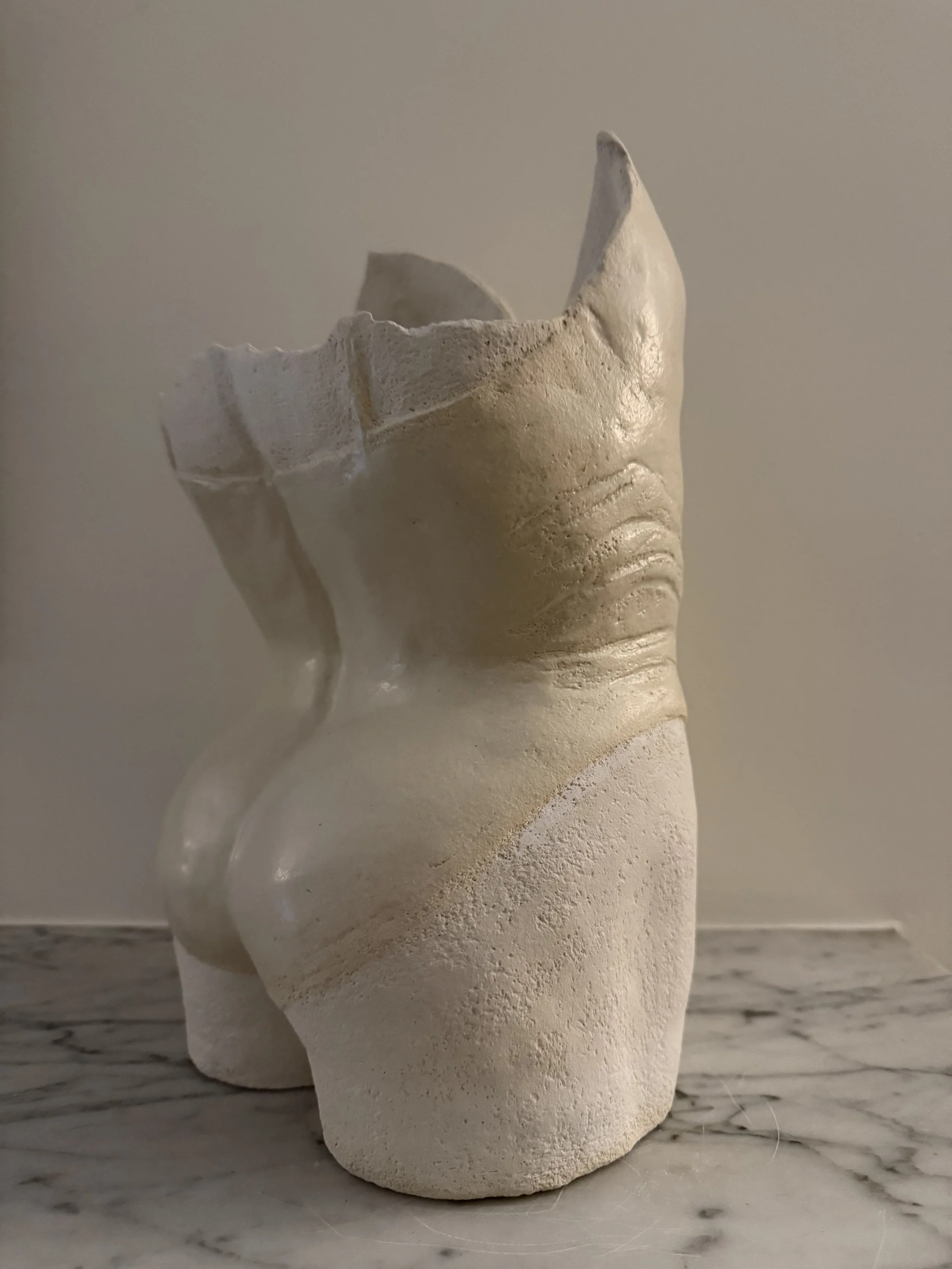
Balanchine
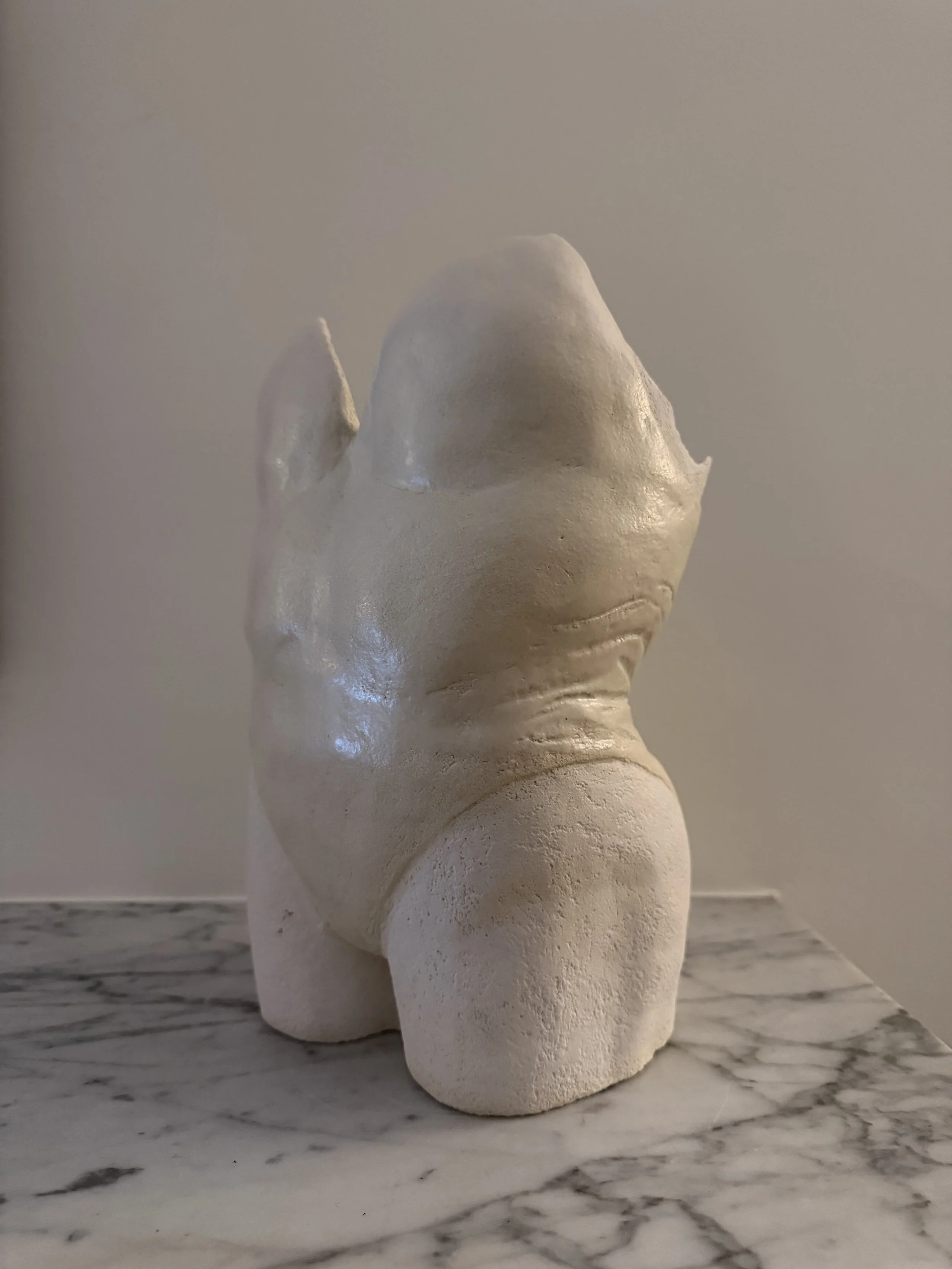
In Balanchine, the body is condensed into a compact, vibrant form, as if a dance step had been translated into mass. The white ceramic catches the light in subtle shifts between matte and soft satin, giving the volume an almost breathing presence. Without head or arms, the figure asserts itself through its center: chest, abdomen, hips, and thighs create a structure of support where anatomy becomes rhythm rather than description.
The sculpture unfolds through a tension between expansion and restraint. From the front, the torso seems to open and gather again, like a controlled breath. In profile and from behind, the push of the legs and the curve of the hips suggest an impulse about to unfold. Subtle surface transitions and modeling variations maintain a gentle instability, as though the form were continually adjusting itself.
Here, the fragment concentrates what matters. Nothing extraneous, only weight, balance, and momentum. The material holds the movement within it, offering a body that feels precise, sensitive, and quietly charged with emotion.
Material: PRAF with glace
Price: €1500
29h x 16w x 16d